

By Andy Callif, licensed Ohio surety bail bond agent (license 594192; Callif Bonding LLC license 42586). Reviewed November 2026.
How does a bail bond work in Ohio? An insurance company, acting through a licensed bail bond agent, promises the court the full bail if the defendant fails to appear. The defendant promises to come to every hearing, and a co-signer promises to repay the insurer for any loss. When the case ends, the court releases the bond.
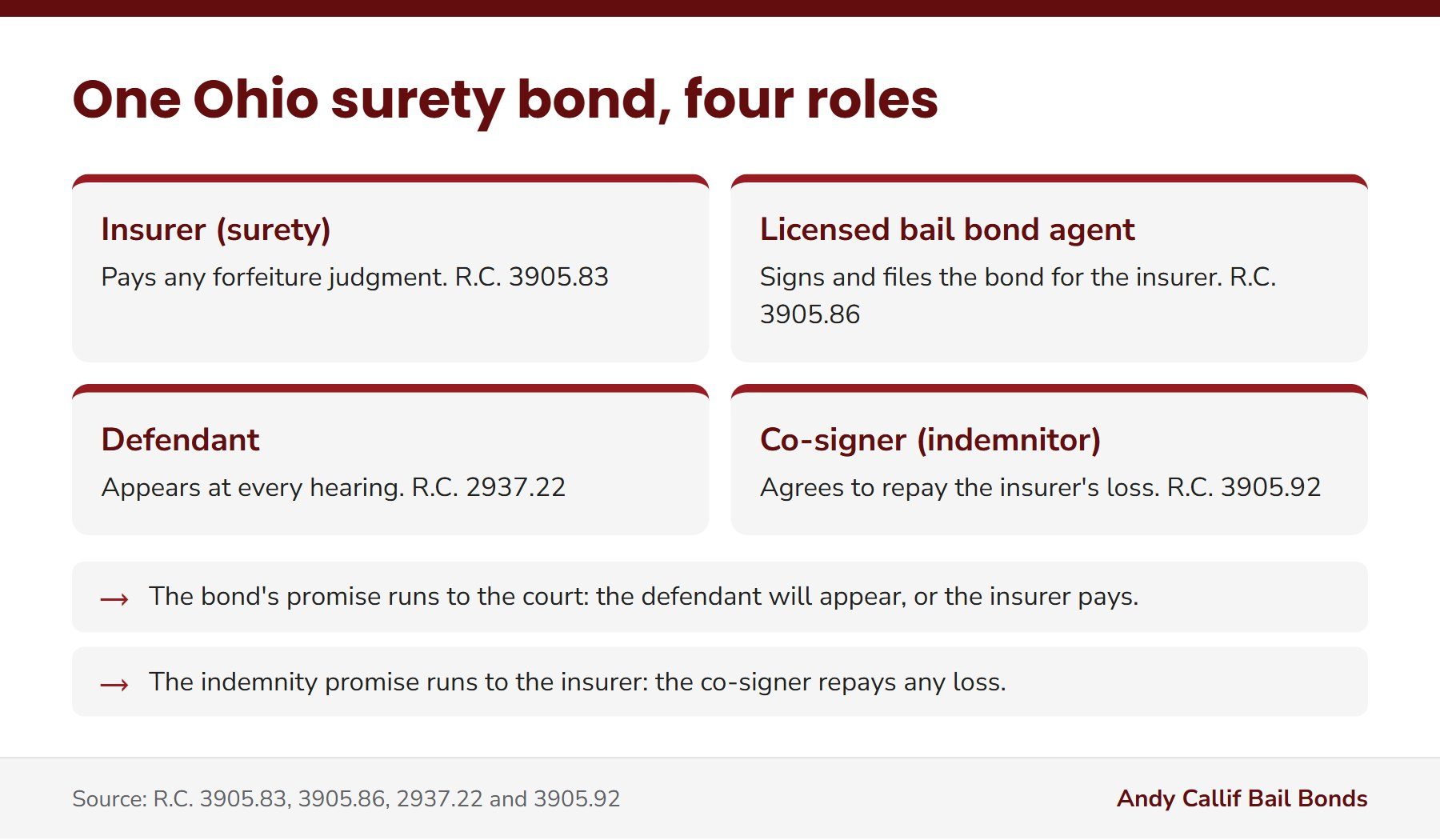
Andy Callif Bail Bonds wrote this explainer for people asked to sign a bond in Franklin County, Delaware County and the counties around them. It walks through each party’s promise, what the agent files with the court, and the two ways a bond comes to an end.
What is a bail bond?
A bail bond is a signed guarantee, filed with the court, that a defendant will return for every required hearing. The Ohio Revised Code (R.C.) describes bail as security for the appearance of an accused, and it can take the form of cash, qualifying government bonds or a recognizance: a written undertaking to forfeit a set sum if the accused does not appear (R.C. 2937.22).
A surety bail bond is that written undertaking given by an insurance company, so the court holds the insurer’s promise instead of the defendant’s money. Where a bond order sets full security, R.C. 2937.011(C)(3) leaves the defendant to pick among a surety bond, real estate or securities, and cash.
Bail vs. bond
People use the two words interchangeably, and so do many jail listings. In the strict sense, bail is the security the court demands, and a bond is the document that supplies it. Recognizance, the court’s 10% deposit and the other release types a judge can order are compared in What Are the Types of Bail in Ohio?
What is the purpose of bail?
Bail is there to bring the defendant back, not to punish. Under R.C. 2901.05, a person accused of an offense is presumed innocent until proven guilty beyond a reasonable doubt, so most people can wait for trial at home if something of value rides on their return. R.C. 2937.011 also tells judges to keep money conditions no more costly than it takes to secure that return.
Who are the parties to a bail bond?
Three sides sign on to an Ohio surety bond, and a fourth, the court, receives its central promise. The surety side is really two players: the insurer and the licensed agent who signs for it.
| Party | Its role on the bond | What qualifies it | Ohio law |
|---|---|---|---|
| Insurer (the surety) | Takes on the debt if the defendant does not return, and pays any forfeiture judgment | A certificate of authority from the Superintendent of Insurance to write surety business in Ohio | R.C. 3905.83(A), (C) |
| Surety bail bond agent | Signs and files the bond for the insurer, collects the premium, holds any collateral and follows the case | An Ohio Department of Insurance license plus an appointment from the insurer | R.C. 3905.84, 3905.86 |
| Defendant (the principal) | Appears at every hearing and keeps the release conditions | The court sets the bail and the conditions | R.C. 2937.011 |
| Indemnitor (co-signer) | Agrees in writing to repay the insurer’s loss, sometimes backed by pledged collateral | Accepted by the agent and insurer; Ohio law sets no list of who may sign | R.C. 3905.92 |
The agent’s signature binds the insurer. An insurer that appoints an agent vouches to the Superintendent of Insurance for the agent’s competence, finances and suitability, and it answers for what the agent does within the agent’s authority (R.C. 3905.86). Some insurers also use a managing general agent to supervise the bail business their agents write in Ohio.
The defendant’s promise runs to the judge. The co-signer’s promise, usually an indemnity agreement, runs to the insurer through the agent, and Ohio’s collateral statute counts that agreement as a form of security the agent can hold. Signing for someone else is explained in What Does It Mean to Co-Sign a Bail Bond?
What does the bail bond agent promise the court?
The agent promises that the defendant will appear, and that the insurer will pay the bond amount if the defendant does not. That undertaking is the bond. The court holds no cash from the agent. It holds a bail instrument issued for the insurer, which is the only thing R.C. 3905.932(G) lets an agent post on court-set bail, apart from narrow exceptions such as cash court fees and ten percent assignments.
To file that instrument in an Ohio court, the agent must be licensed, appointed and, where the court requires it, registered with the clerk (R.C. 3905.87). The agent gives the clerk its bail bond license, photo identification such as a driver’s license, and a certified copy of each insurer’s power of attorney appointment, and renews that filing every two years, with April 1 of odd-numbered years as the deadline.
Two local examples show how this works in practice:
- Delaware County: the Clerk of Courts keeps the list of approved agents for the Common Pleas Court, General Division, and shares it with the holding facilities in the court’s jurisdiction. An agent who cannot produce a defendant after a forfeiture can face judgment, a report to the Ohio Department of Insurance and removal from that list (Delaware County Clerk of Courts, page updated Aug. 3, 2022). Delaware, OH Bail Bonds in Delaware County covers bonds there.
- Franklin County: the Franklin County Municipal Court Clerk takes bonds around the clock at its Criminal/Traffic Division, 375 S. High St., second floor, and keeps a phone line reserved for bail bond agents. The jail receives a release form from the clerk once the bond is in (Franklin County Municipal Court Clerk, checked Oct. 18, 2026). Franklin County Jail and Courts: How Bail Works explains which courts handle which cases.
What the agent does not promise is a release time or a result in the case. The jail controls the release, and the judge controls the case.
How does a bail bond work from posting to discharge?
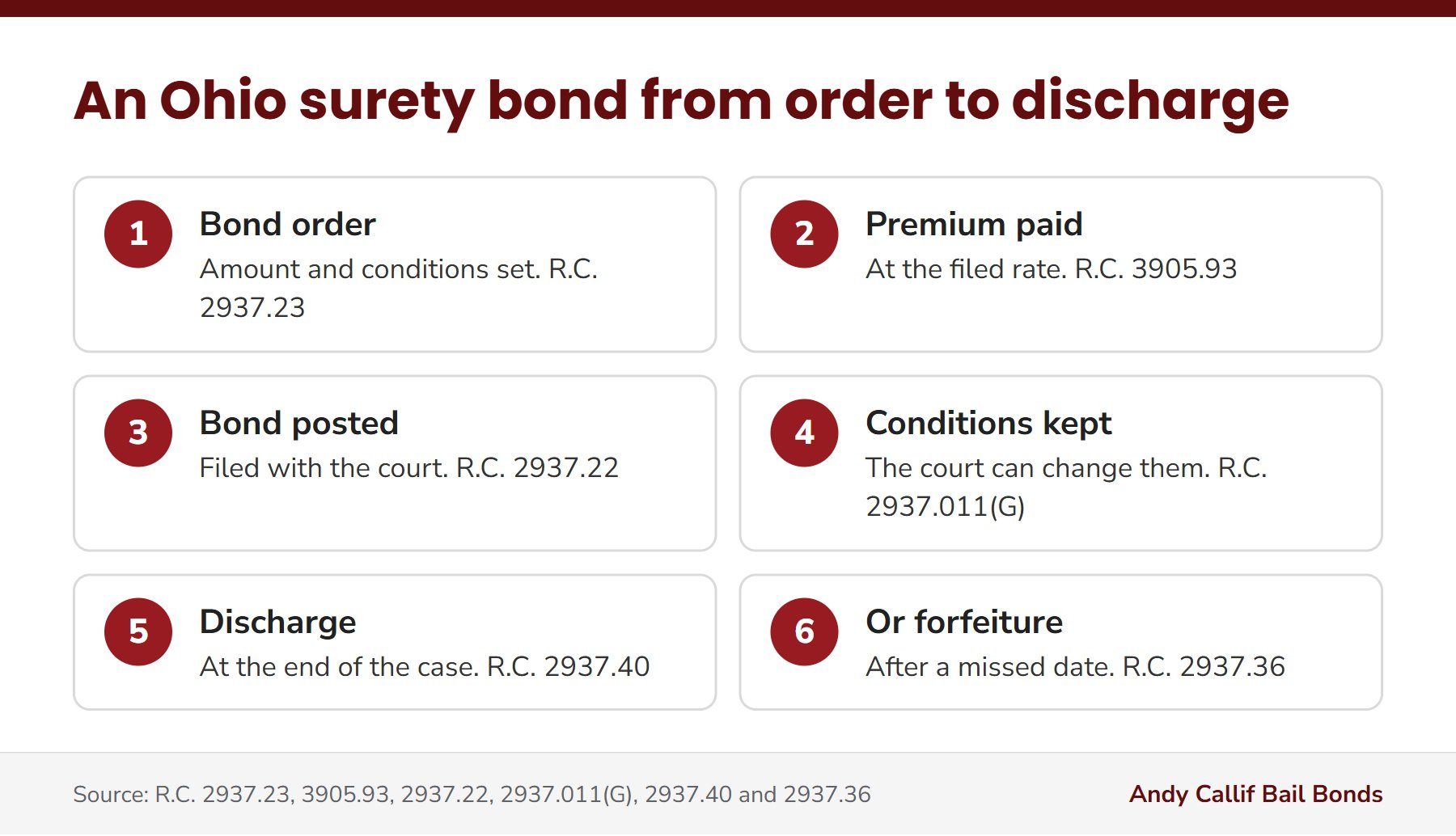
Every surety bond passes through the same six stages, starting with the bond order and closing with the court’s final entry. The table lists each stage and the Ohio rule behind it.
| Stage | What happens | Ohio rule |
|---|---|---|
| 1. Bail is set | A judge or magistrate sets bail on a felony; on a misdemeanor, a clerk can apply the court’s schedule. The order names the amount, the types allowed and the conditions. | R.C. 2937.23; 2937.011(C) |
| 2. The agent weighs the risk | The agent checks the court, charge, amount and bond type, then decides whether the insurer will write the bond and what security it needs, such as a co-signer or collateral. | R.C. 3905.92 |
| 3. Signing and paying | The defendant and any co-signer sign the application and agreements. The premium follows the approved rate, the only other cost is the filing fee the court sets, and collateral gets a numbered written receipt. | R.C. 3905.93; 3905.92(A)(4) |
| 4. Posting | The agent hands the bond to the clerk, deputy clerk or magistrate who takes bail for that court, and the jail processes the release. | R.C. 2937.22(C); 3905.87 |
| 5. The case is open | The defendant attends every hearing and follows each condition. The release conditions stay in force through the verdict, or through a plea of guilty or no contest, and the judge may extend them pending sentence or appeal. | R.C. 2937.011(G) |
| 6. The bond ends | The court discharges the bond, or a missed date sets off forfeiture. | R.C. 2937.40; 2937.35 and 2937.36 |
Bail is set after an arrest
No agent can write a bond until bail is set. R.C. 2937.23 has a judge or magistrate set bail on felonies and lets a judge, magistrate or clerk set it on misdemeanors from a schedule the court has adopted. In every case, the amount reflects how serious the charge is, the person’s record and how likely the person is to appear. How Much Will My Bail Be? explains those factors.
How do you get a bail bond?
Getting one starts with a call to a licensed agent once the bond order allows a surety bond. The family supplies the defendant’s details and the case information, reads and signs the agreements, and pays the premium and fee. For the practical steps at Ohio jails, read How Do I Bail Someone Out of Jail in Ohio?, and for how our office runs each step, see Our Bail Bond Process.
What does it mean to post bond?
To post bond is to deliver the security the court requires so the jail can let the defendant go. With a surety bond, posting means the agent files the insurer’s bond with the clerk, and no bail money changes hands with the court. Who holds each dollar under the other options is set out in Where Does Bail Money Go in Ohio?
How does a bail bond end?
A bond ends in one of two ways: the court discharges it, or the defendant misses court and the court forfeits it. Which one happens decides whether anyone pays the bond amount.
When the defendant makes every date
R.C. 2937.40(A) releases a surety on a bond in three situations. The defendant shows up when the bond requires and the case reaches a judgment entry. The surety turns the defendant in before the appearance date, in open court or through a written request that ends with the sheriff holding the defendant. Or, once a default has happened, the surety satisfies the court with a payment capped at the lower of the bond and the forfeiture order.
Bond exonerated means the court has released the bond and nobody owes anything more on it, which What Does It Mean When Bail Is Exonerated? explains along with how to confirm it.
After discharge, collateral goes back undamaged to whoever pledged it, and the insurer must return it if the agent does not (R.C. 3905.92). The premium is earned the moment the bond is posted, so it does not come back. Will Bail Money Be Returned? covers what does come back.
When the defendant misses court
A missed date turns the insurer’s promise into a debt. The judge can order the bail forfeited in open court, or postpone to a fixed later date after giving notice to the defendant and the surety (R.C. 2937.35). Once bail is forfeited, the clerk gets 15 days to mail a notice to the defendant and every surety, and that notice sets a show-cause date between 45 and 60 days out (R.C. 2937.36(C)).
- If the defendant is brought back by the show-cause date, that counts as good cause, and the surety can ask the court not to enter judgment.
- If not, the court enters judgment against the surety, capped at the bond’s penalty, and it is collected like a civil judgment.
- A defendant who later appears, surrenders or is rearrested on the charge gives the court grounds to remit some or all of the penalty (R.C. 2937.39).
- An agent with a bond judgment still unpaid 60 days after appeals end cannot write another bond in Ohio unless the full amount is deposited with the clerk (R.C. 3905.932(K)).
- The insurer can then look to the co-signer under the indemnity agreement. Pledged collateral can be turned into cash only after the agent or insurer gives the pledger ten days’ notice in writing, sent certified mail (R.C. 3905.92(D)).
For the co-signer’s side of a forfeiture, read What Happens If You Bail Someone Out and They Run? The defendant’s side, including the warrant, is in What Happens If You Miss Court While Out on Bail?
My advice once the bond is posted: stay in touch with our office, by stopping in or by phone, and call us for every court date. Our work does not end at release; we can help you through each stage of the court process, whether the case wraps up in a few weeks or runs for years.
How does a bail bondsman work?
A bail bond company is a licensed agency that writes surety bonds for the insurers that have appointed it. The business holds its own Ohio license and must name a licensed agent to oversee its compliance (R.C. 3905.85). It earns the premium on each bond it writes, and the insurer behind it carries the risk of paying a forfeiture.
The agent must charge the rate the Superintendent of Insurance approved, as How Much Does a Bail Bond Cost in Ohio? explains. Because the insurer pays when a defendant disappears, the company screens each case, asks for co-signers and collateral where the risk calls for them, stays in touch with the defendant and tracks every court date until the bond is discharged.
Ohio’s licensing rules for bail bond agents
Bail bonds in Ohio are insurance, so the Ohio Department of Insurance licenses the people who write them under R.C. 3905.83 to 3905.95. The main rules:
| Rule | What Ohio requires | Section |
|---|---|---|
| License and appointment | No one may serve as a surety bail bond agent unless qualified, licensed and appointed | R.C. 3905.84 |
| Getting licensed | A $150 application fee, a minimum age of 18, the required education and state exam, and a criminal records check for residents. A newly licensed individual cannot execute bonds for the first 180 days | R.C. 3905.85 |
| Staying licensed | Renewal every year by April 1, with a minimum of 7 hours of approved continuing education per renewal period, one of them in ethics | R.C. 3905.85, 3905.88 |
| Insurer appointment | The insurer files notice of each appointment with the superintendent and answers for the agent’s acts within its authority | R.C. 3905.86 |
| Court registration | Registration with the clerk wherever a court requires it, renewed every two years | R.C. 3905.87 |
| Collateral | Proportionate to the bond, receipted, held in a fiduciary capacity and kept apart from other funds | R.C. 3905.92 |
| Price | The approved premium rate, plus the filing fee the court sets on every bond | R.C. 3905.93 |
| Conduct | No rebates to the defendant, no soliciting at jails or courts, no steering to a lawyer and no bonds written on the agent’s own behalf | R.C. 3905.932 |
| Advertising | Every ad must carry the address of record the agent has filed with the department | R.C. 3905.934 |
Any agent’s license can be checked on the Ohio Department of Insurance Agent/Agency Locator, and What Should You Ask Before Hiring a Bail Bondsman? lists the questions to put to an agent before you sign.
Common bail bond terms
Bond paperwork has its own vocabulary. These are the words most families meet first.
| Term | What it means in Ohio |
|---|---|
| Principal | The defendant, whose appearance the bond secures |
| Surety | The insurance company that takes responsibility for the defendant’s obligation to appear if the defendant defaults (R.C. 3905.83(C)) |
| Surety bail bond agent | The licensed, appointed person who signs and files bonds for the insurer |
| Indemnitor | A co-signer who agrees to repay the insurer’s loss on the bond |
| Premium | The price of the bond, charged at the rate the Superintendent of Insurance approved |
| Court filing fee | The fee each county and court sets on every bond; it goes to the court and is not an office charge |
| Collateral | Security pledged to secure the bond and returned when liability ends |
| Power of attorney | The insurer’s written authority for the agent to bind it on bonds; courts that register agents keep a certified copy |
| Bond order | The judge’s entry that sets the bail amount, the types of bail allowed and the release conditions |
| Bail schedule | A court’s preset list of bail amounts for misdemeanors, which a clerk can apply without waiting for a judge (R.C. 2937.23) |
| Bail hearing | A court hearing where a judge sets or reviews the bail and the conditions |
| Recognizance | A written promise to forfeit a set sum if the accused does not appear (R.C. 2937.22) |
| Forfeiture | The court’s declaration, after a missed appearance, that the bail is lost (R.C. 2937.35) |
| Remission | The court giving back all or part of a forfeited penalty after the defendant returns (R.C. 2937.39) |
| Exoneration | The court’s release of the bond; no one is liable on it afterward |
| Surrender | The surety returning the defendant to custody before the appearance date, which discharges it (R.C. 2937.40) |
| Bail jumping | Missing a required court date after release. After a recognizance release, Ohio makes it a separate crime, graded by the underlying charge: a fourth-degree felony if that charge is a felony, a first-degree misdemeanor if it is a misdemeanor (R.C. 2937.99) |
Searches for codes such as a “NOMAP bond” usually trace to jail systems in other states. That label is not one of the bond types in Ohio’s statutes, so check what a listing means with the court clerk before any money changes hands.
Clearing up common misconceptions about bail bonds
These myths still circulate online and in conversation. Here is what Ohio law says instead.
- “Any bondsman can charge whatever premium it likes.” Not so. Under R.C. 3905.93, the only lawful premium is one charged at a rate the Superintendent of Insurance has approved. The court’s own 10% deposit under R.C. 2937.011(C)(2) is a different payment, made to the clerk and mostly refunded.
- “Bail is a punishment.” Bail is security for coming back to court, and a person out on bail is still presumed innocent.
- “Everyone can bond out.” Not always. For murder, non-capital aggravated murder, first- and second-degree felonies and some other offenses the statute lists, bail can be denied after a hearing under R.C. 2937.222. What Crimes Are Bailable in Ohio? covers which charges qualify.
- “You owe the rest of the bail when the case ends.” If every date is kept and the bond is discharged, the bond itself creates no further debt.
- “Out on bail, you can do as you like.” Courts attach conditions such as no-contact orders and check-ins, and breaking one can cost the release. What Are the Conditions of Bail? lists them.
- “The bondsman keeps your collateral.” Collateral belongs to the person who pledged it. The agent only holds it as a fiduciary and must return it when the bond’s liability is over.
What release on a bail bond means for the defendant
Release does not end the case. It changes where the defendant waits for it, which shapes how the defense gets prepared. Out of custody, a defendant can:
- Meet a defense lawyer in an office instead of a jail visiting room, and help track down records and witnesses
- Keep working, stay in school and care for family while the case is open
- Walk into court in their own clothes
- Keep up with pretrial check-ins, testing or treatment the court orders
Ohio law also tries to keep release within reach. R.C. 2937.011(B) tells the court to choose the lightest conditions that will still bring the defendant back, and to keep any money condition to the least costly amount and type that serves that purpose. When the court still requires full security, a surety bond lets a family meet it by paying the filed premium instead of tying up the whole bail, which puts release on the same footing for people who do not have that cash on hand. That is why bail bonds are often described as an equaliser in the pretrial system. Getting out also keeps the practical pieces of life in place: the defendant can stay in a job, keep housing and care for children while the case is open, which also helps the defense.
Questions about how a bail bond works? Call Andy Callif Bail Bonds
If a bond is being set for someone you know and you want every signature explained before you give one, call (614) 221-0100, day or night. Andy Callif Bail Bonds, with 900+ Google reviews, can tell you who signs, what we file with the court and when your part ends. If writing is easier, Contact Us reaches the same office.
Andy Callif Bail Bonds (Callif Bonding LLC), 350 S. High St., Columbus, OH 43215
This guide describes Ohio bail bond law in general terms and is not legal advice. For your own case, speak with an Ohio criminal defense attorney.
Frequently asked questions
How do bail bonds work?
On behalf of an insurance company, a licensed agent puts up a bond covering the whole bail, and that insurer guarantees the court that the defendant will appear. The family pays the approved premium plus the court’s filing fee and may add a co-signer or collateral. If every date is kept, the court releases the bond.
What does out on bond mean?
It means the defendant has left jail because bail was met, whether by cash, a court deposit, a recognizance or a surety bond. The case is still open, and the person must return for every hearing and follow the release conditions.
What does it mean to post bond?
Posting bond means giving the court the security it set so the jail can release the defendant. On a surety bond, the agent files the insurer’s bond with the clerk, so no one has to pay the full amount in cash.
What is a bail bond company?
A business licensed by the Ohio Department of Insurance to write surety bail bonds for the insurers that appoint it. It charges the approved premium, takes co-signers and collateral as security, and keeps track of the case until the bond is discharged.
How do bail bond companies make money?
From the premium on each bond, charged at the rate the Superintendent of Insurance approved. The filing fee the court adds to each bond goes to the court, not to the company. The company and its insurer bear the loss if a forfeited bond has to be paid.
Is bail the same thing as a bond?
Bail is the security a court requires for release. A bond is the document that provides it, such as a recognizance or an insurer’s surety bond. In everyday speech, the two words mean the same thing.
What is bail jumping?
Bail jumping means missing a required court date after release. The court can forfeit the bail, and R.C. 2937.99 makes failure to appear its own offense for someone freed on a recognizance.
Who pays if the defendant misses court on a bail bond?
The insurer answers to the court and can be ordered to pay as much as the full bond if the defendant is not returned by the show-cause date. It can then collect from the co-signer under the indemnity agreement, and pledged collateral can be converted after written notice.
What are the alternatives to a bail bond?
Depending on the bond order, a defendant may go home on a recognizance or an unsecured bond without paying anything at release, post the court’s 10% deposit when the order allows it, or put up full cash, real estate or securities (R.C. 2937.011(C)). The judge decides which options are open.
Is a surety bond the same as a bail bond?
In Ohio criminal cases, a bail bond written by a licensed agent is a surety bond, because an insurer stands behind it. Courts also accept cash, deposits and other forms of bail, which work differently.