

By Andy Callif, licensed Ohio surety bail bond agent (license 594192; Callif Bonding LLC license 42586). Reviewed November 2026.
To take care of a warrant without going to jail in Ohio, you need the court that issued it to agree. A defense attorney can ask the judge to set the warrant aside or recall it, and some courts hear that request in person. If the judge says no, a planned surrender with a bond already lined up is the next route.
No one can promise that a warrant will be cleared without custody, and that includes Andy Callif Bail Bonds. This guide explains each lawful option the way Ohio’s court rules and the courts in Franklin and Delaware counties describe it, so you can choose a next step with your lawyer.
How to take care of a warrant without going to jail
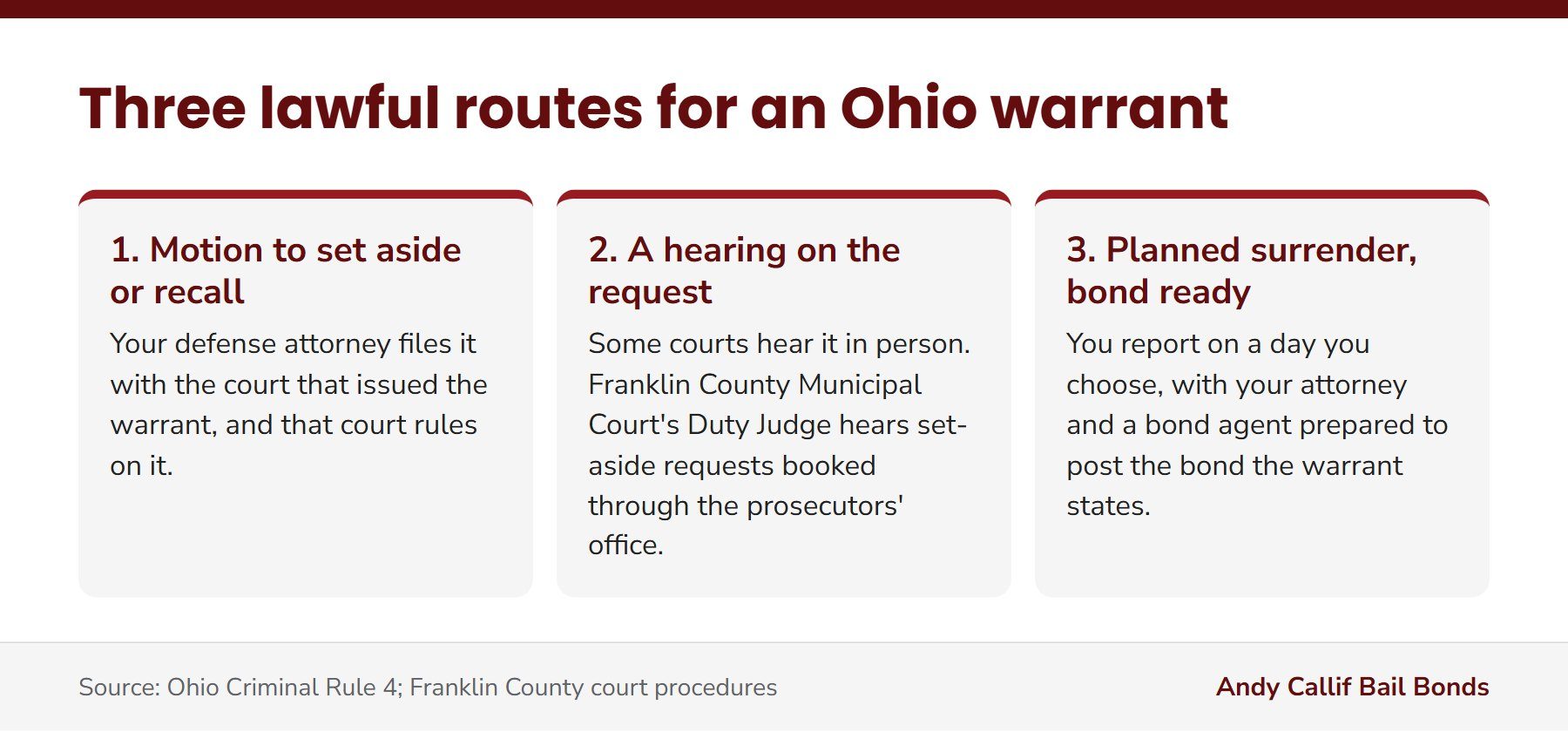
You have three lawful ways to get rid of a warrant or limit the time it costs you, and the judge decides which one fits. The table compares them using only what Ohio’s rules and the courts themselves publish.
| Route | How it starts | What the official source says | Can it avoid custody? |
|---|---|---|---|
| Motion to set aside or recall the warrant | Your defense attorney files it with the court that issued the warrant | The court that issued the warrant rules on the motion; some judges decide it on the papers, others require you to appear and may set bond at that hearing | Sometimes, if the judge grants it |
| Hearing on a set-aside request | You or your attorney schedule time before a judge | Franklin County Municipal Court’s Duty Judge hears warrant set-aside requests, booked through the prosecutors’ office | Possibly, but the judge may also set a bond or order you held |
| Planned surrender with a bond ready | You report on a day you choose, with your attorney and bond agent prepared | Ohio Criminal Rule 4 says a warrant issued after a first court appearance must state one of two things: post a set cash or secured bond, or stay in custody until seen by the court | No. You are booked, but a ready bond can shorten the stay when bail is listed |
A warrant stays open until a judge cancels it or police serve it, so what you control is whether it gets handled on your schedule or theirs.
Asking the judge to set aside or recall the warrant
A motion to set aside a warrant, also called a motion to recall or quash it, asks the judge to cancel the arrest order and give you a new court date. This is the main way to get a warrant dropped without a jail stay, but the judge is free to deny it.
No Ohio adult court publishes a promise that the motion will be heard without you there. Some judges rule on the papers; others want you in the courtroom, and may set a bond on the spot. Ask your lawyer how the judge on your case treats these motions.
Give your lawyer anything that explains why the date was missed, plus your current address and phone number. The court uses that contact information for the next notice.
Court-specific walk-in procedures
Each court sets its own process for warrant requests, and none of them promises you will leave without being held. Here is what each court publishes (checked October 2026):
- Franklin County Municipal Court (misdemeanors, traffic and OVI cases, and the early stages of felonies). The judge assigned to the Duty Room, Courtroom 10C, hears requests for warrant set-asides. The court’s page lists no walk-in set-aside hearings; parties schedule one by calling the prosecutors’ office, (614) 645-7483. For more on bench warrants from that court, read Columbus Bench Warrant Bail Bonds.
- Franklin County Juvenile Branch. A youth can come to court with a parent during business hours and ask the magistrate to set the warrant aside, or surrender at the Juvenile Detention Center, 399 S. Front St. Reporting there before 7 a.m. can place the case on that day’s preliminary hearing docket.
- Franklin County Court of Common Pleas (felony indictments). We found no public walk-in procedure; your defense attorney takes the warrant up with the assigned judge.
- Delaware Municipal Court (Delaware County misdemeanor and traffic cases). The court’s website lists no walk-in warrant procedure. It keeps weekday hours, 8 a.m. to 4 p.m., at the Justice Center, 70 N. Union St.; the Criminal/Traffic Division number is (740) 203-1570.
- Delaware County Court of Common Pleas (felonies). Confirm the case and the assigned judge with the Delaware County Clerk of Courts, 117 N. Union St., Level 300, (740) 833-2500, then have your attorney contact that judge’s court.
For booking and bond in Delaware County, see Delaware County Jail and Courts: How Bail Works.
How does the warrant walk-through process work?
A walk-through is a planned, voluntary surrender: you pick the day, arrive with your paperwork in order, and post bond after booking if the warrant or a judge allows it. The steps are the same for a misdemeanor or a felony warrant:
- Confirm the warrant and the court that issued it. Our Columbus Warrant Bail Bonds page lists the official Franklin County case searches; in Delaware County, start with the clerk for whichever court has the case.
- Find out what the warrant says about bail. Ohio Criminal Rule 4 has every warrant note its timing. A warrant from before the person’s first court date leaves bail to the judge, while a later one either names a bond or says to hold the person without bail.
- Talk with your defense attorney. Ask whether a set-aside motion should be filed first and whether the lawyer will go with you.
- Line up the bond. Give our office the case number, the issuing court and the amount on the warrant so the surety paperwork is finished before you report.
- Report where your attorney or the court tells you to go. Bring a government-issued photo ID and your court papers.
- Get booked. A bail amount written on the warrant can be posted after booking; with no amount listed, you wait for the judge to decide bail.
If the warrant says no bail, a surrender can still be the better choice, but plan on staying in custody until the issuing court sees you. Criminal Rule 4 says that hearing must happen without unnecessary delay.
My advice before a walk-through never changes: call our office first, and we will say how to handle the surrender. In Franklin County a misdemeanor warrant on something like theft or a traffic offense usually carries a preset bond, and it may be posted without any judge stepping in. Outside Franklin County, a judge generally sets the bond first, and most counties take bonds only on weekdays and only until 4 p.m., felony bonds in particular.
How long does the walk-through process take?
Ohio sets no time limit for a walk-through, and nobody can promise you a release time. These are the things that make it shorter or longer:
- Whether the warrant lists bail or a judge has to set it. In the Franklin County Municipal Court, the Clerk’s Criminal/Traffic Division says bond on felony and domestic violence cases is set in arraignment court, which begins at 9:00 a.m.
- Whether the bond paperwork was finished before you arrived
- How many warrants or holds you have, including any from other counties
- How busy booking is that day
- How quickly the jail processes the release. In Franklin County, the Clerk’s office notifies the jail with a release form after the bond is posted, and the Sheriff’s Office answers timing questions at (614) 525-3368
Turning yourself in on a warrant: when to go
No court rule names a best day or hour. Try to arrive while the court that will set your bail is in session.
For most people that means a weekday morning: the Franklin County Duty Room sits Monday through Friday, and the Delaware Municipal Court keeps weekday hours. If you are wondering how late you can turn yourself in, ask your attorney or the jail first, because a late-night report can mean waiting overnight for the next session.
Who is eligible for a warrant walk-through?
Ohio has no list of who qualifies; it comes down to the warrant and the judge. These questions usually matter most:
- Does the warrant name a bond, or does it say to hold you without bail?
- Is it a new charge, a grand jury indictment, or a missed date in a case that is already open? Under Criminal Rule 9, the clerk issues an indictment warrant when the prosecutor asks for one.
- Is another case already open, with you on bond or supervised by probation? R.C. 2937.011 has judges weigh that, your record of coming to court and the nature of the charge, including any weapon, when they decide bail.
- Do other courts or counties have warrants or holds for you?
A no-bail warrant or a serious charge makes a quick release less likely, but the decision still belongs to the judge.
What are the benefits of a planned surrender?
A planned surrender trades a surprise arrest for a day you prepared for:
- You choose the day and arrange work, child care and a ride ahead of time
- Your attorney can come with you, or at least knows when you are reporting
- The bond paperwork is ready before booking starts
- You arrive with your court papers and a written list of phone numbers instead of being picked up without them
- It shows the court you came in on your own, and judges weigh a person’s record of appearing when they set bail
Surrendering does not end the case. The original charge stays open, and the bond comes with a new court date and conditions you have to follow.
Can you post bail before turning yourself in?
Not quite. You can arrange the bond in advance, but it is posted only after you are in custody on the warrant and the amount is known.
Where the amount comes from depends on the warrant. When a warrant issued after a first appearance lists bail, Criminal Rule 4 gives the arresting officer two choices: accept the bond written on it, with a set date to return to court, or bring you to the issuing court without unnecessary delay. When the warrant predates a first appearance or is silent on timing, the judge sets bail once you are brought in. If a judge has to set the amount, What Happens at a Bail Hearing? walks through that first hearing.
In Franklin County, people paying a Municipal Court bond can use interactive kiosks at a Columbus corrections center that connect them by video to a deputy clerk, who checks a government-issued ID before taking cash or a credit card, according to Court News Ohio (Oct. 27, 2025). For how bond types differ, see What Are the Types of Bail in Ohio?
What a bail bond agent can and cannot do
A bond agent handles the money side of a surrender, not the warrant itself. Here is where that line falls:
| A bail bond agent can | A bail bond agent cannot |
|---|---|
| Go over the case number, court and bond amount with you or your attorney before you report | Cancel, recall or quash a warrant |
| Finish the surety bond paperwork ahead of time | Promise a release time |
| Post the bond once you are booked | Speak to the judge for you or set the bail amount |
| Explain the court date and conditions that come with release | Make the underlying charge go away |
For a surety bond you pay a premium, which is the fee for the guarantee. Under R.C. 3905.93, the premium a bail bond company collects must match the rate it has filed with Ohio’s Department of Insurance. For what goes into the price, read How Much Does a Bail Bond Cost in Ohio?
When the warrant stems from a missed court date, reach out to our office that same day. We can talk with your public defender, and on occasion the court, about scheduling a new date. You do not have to hide, and calling early gives us more room to help.
Do I need a lawyer to take care of a warrant?
You are not required to hire one, but a defense attorney is the person who files the motion that might end the warrant without custody, so talk to one before you report.
Ohio’s Constitution guarantees an accused person the right to appear and defend with counsel (Article I, Section 10). A lawyer can contact the prosecutor or the court before a surrender and stand with you at the hearing. If you cannot afford one on a state charge in Columbus, the Columbus City Attorney’s office refers people to the Franklin County Public Defender; elsewhere, ask the court about appointed counsel.
Remember your rights
The same section of the Ohio Constitution says no person can be compelled in a criminal case to be a witness against himself. Say politely that you will not answer questions about the case without your lawyer, and then stop talking about the facts.
What is a warrant?
A warrant is a court order. An arrest warrant directs officers to arrest the person it names, and a search warrant lets them search a place for evidence. In Ohio, an arrest warrant on a complaint issues when a judge, magistrate or clerk finds probable cause that a crime happened and that the person committed it. Not every charge starts this way: the court can send a summons instead, which orders you to appear on a given date.
How long does it take for a warrant to be issued in Ohio?
There is no waiting period. A warrant can issue as soon as a complaint is filed and probable cause is found, and after a grand jury indictment, Criminal Rule 9 tells the clerk to issue one forthwith when the prosecutor asks. A bench warrant follows a missed court date or another broken court order.
Types of warrants
| Type | Who issues it | Common reason |
|---|---|---|
| Arrest warrant | A judge, magistrate or clerk on a complaint, or the clerk after an indictment | A new criminal charge |
| Bench warrant | The judge who has the case | A missed court date, unpaid fines or a probation violation |
| Search warrant | A judge | Evidence of a crime at a place; it is not an order to arrest you |
Bench warrants get their own guide, What Is a Bench Warrant?, and if one came from a missed date, read What Happens If You Miss Court While Out on Bail? for what it means for the first bond.
How to check whether you have a warrant
Search the case records of the court you think issued it, and have a lawyer confirm what you find. In my experience every county works the same way: look up that county’s clerk of courts online and run the name in its case search, or call our office for a free warrant check and we will look it up for you. The Franklin County Municipal Court Clerk releases current warrant details only to an attorney who gives a Supreme Court registration number it can verify. For how booking and bond run in that county, see Franklin County Jail and Courts: How Bail Works. In Delaware County, call the clerk of the court that would have the case.
Do warrants expire in Ohio?
No. A warrant stays in force until it is served or a judge cancels it, however old it is. Ohio’s charging deadlines in R.C. 2901.13 are a separate question: the statute treats a warrant as starting the prosecution only when the state makes a reasonably diligent effort to serve it. Ask a lawyer how that applies to an old warrant.
The do’s and don’ts of an arrest warrant
A few choices made in the first days after you learn about a warrant shape everything that follows:
| Do | Don’t |
|---|---|
| Call a defense attorney before anyone else | Ignore the warrant and hope it goes away |
| Confirm the court and the case number | Assume an old warrant has lapsed |
| Plan the surrender and line up the bond | Count on distance; moving or traveling does not cancel an Ohio warrant |
| Keep every court paper and give the court your current address | Talk about the facts of your case with officers before speaking with your lawyer |
| Ask the court that issued it about its own process | Pay anyone who claims they can make the warrant disappear; only the court can cancel it |
What you can’t do while a warrant is open
An open warrant follows you until a judge cancels it or police serve it. In the meantime:
- You cannot count on a routine traffic stop staying routine. The warrant shows up when an officer runs your name, and the officer arrests you on it then and there.
- You cannot clear a traffic case by waiting. When a traffic defendant misses court, the court can ask the Ohio BMV to block the person’s license or registration until the case is handled.
- You cannot lawfully buy or carry a gun. Ohio’s weapons laws treat a fugitive from justice as a person under disability, and a sheriff will not issue a concealed handgun license to someone with an open warrant.
- You cannot pass a clean background check. The warrant appears on the Ohio BCI check that employers, landlords and licensing boards run.
- You cannot expect an easy bond later. When you are finally brought in, the judge weighs your record of appearing in court under R.C. 2937.011, and a warrant left open for months counts against you.
- You cannot wait it out. Ohio warrants do not expire, and R.C. 2901.13 treats the charging deadline as met once the state makes a reasonably diligent effort to serve the warrant.
Ready to take care of a warrant in Ohio? Talk to Andy Callif Bail Bonds
Taking care of a warrant without going to jail starts with your lawyer and the court; our part is the bond. If you or a family member plans to surrender on an Ohio warrant, whether the case is in Franklin County, Delaware County or a nearby county, we can have the paperwork finished before you report. Our line, (614) 221-0100, is answered 24/7, or you can send the case details through our contact page. Delaware County cases are covered on Delaware, OH Warrant Bail Bonds.
Andy Callif Bail Bonds (Callif Bonding LLC), 350 S. High St., Columbus, OH 43215
This guide explains Ohio procedure in general terms and is not legal advice; ask your own defense attorney how it applies to your warrant.
Frequently asked questions
How do you clear a warrant without going to jail?
Usually through a defense attorney’s motion. If the judge grants it and sets aside or recalls the warrant, you may not be booked at all. The court decides and nothing guarantees it, so keep a planned surrender with a bond ready as the fallback.
Can a lawyer get a warrant recalled without me there?
It depends on the court and the judge. Some rule on the attorney’s motion with you absent; others require you to appear and may set bond at that hearing. Ask your lawyer what the judge on your case requires.
Can you just pay off a warrant?
Usually not. Posting a bond gets you released with a court date, but it does not close the case, and the bond is posted after booking. If the warrant is tied to unpaid fines or costs, ask the clerk or your attorney whether paying changes anything.
Can you post bail before turning yourself in?
You can arrange the bond in advance, but it is posted after you are in custody on the warrant. When the warrant lists bail, Ohio Criminal Rule 4 lets the arresting officer accept that bond or bring you to the issuing court.
What is the best time to turn yourself in on a warrant?
No rule names one. Aim for a weekday when the court that will set your bail is in session, with your attorney and bond agent ready. In Franklin County Municipal Court, arraignment court begins at 9:00 a.m.
Where do I turn myself in on a warrant?
Ask your attorney or the court that issued the warrant, because the right place depends on the court and the case. In Franklin County, your attorney can schedule a Duty Room set-aside hearing through the prosecutors’ office before you report anywhere.
How long does it take for a warrant to be issued in Ohio?
There is no set waiting period. A warrant can issue once a complaint is filed and probable cause is found, and after an indictment the clerk issues one at the prosecutor’s request.
What happens if I ignore a warrant?
The warrant stays active, so any police contact, even a routine traffic stop, can end in an arrest on the officer’s timing instead of yours. Judges setting bail also weigh a person’s record of appearing in court, so a warrant left alone for months can count against you later.
Do warrants expire in Ohio?
No. An Ohio warrant does not lapse with time; it remains open until it is served or a judge cancels it. Ohio’s separate charging deadlines turn on whether the state tried to serve the warrant with reasonable diligence.
What should I bring when I turn myself in?
A government-issued photo ID, your court papers and your lawyer’s contact information. Write important phone numbers on paper in case you cannot reach your phone, and leave valuables at home.