
By Andy Callif, licensed Ohio surety bail bond agent (license 594192; Callif Bonding LLC license 42586). Reviewed November 2026.
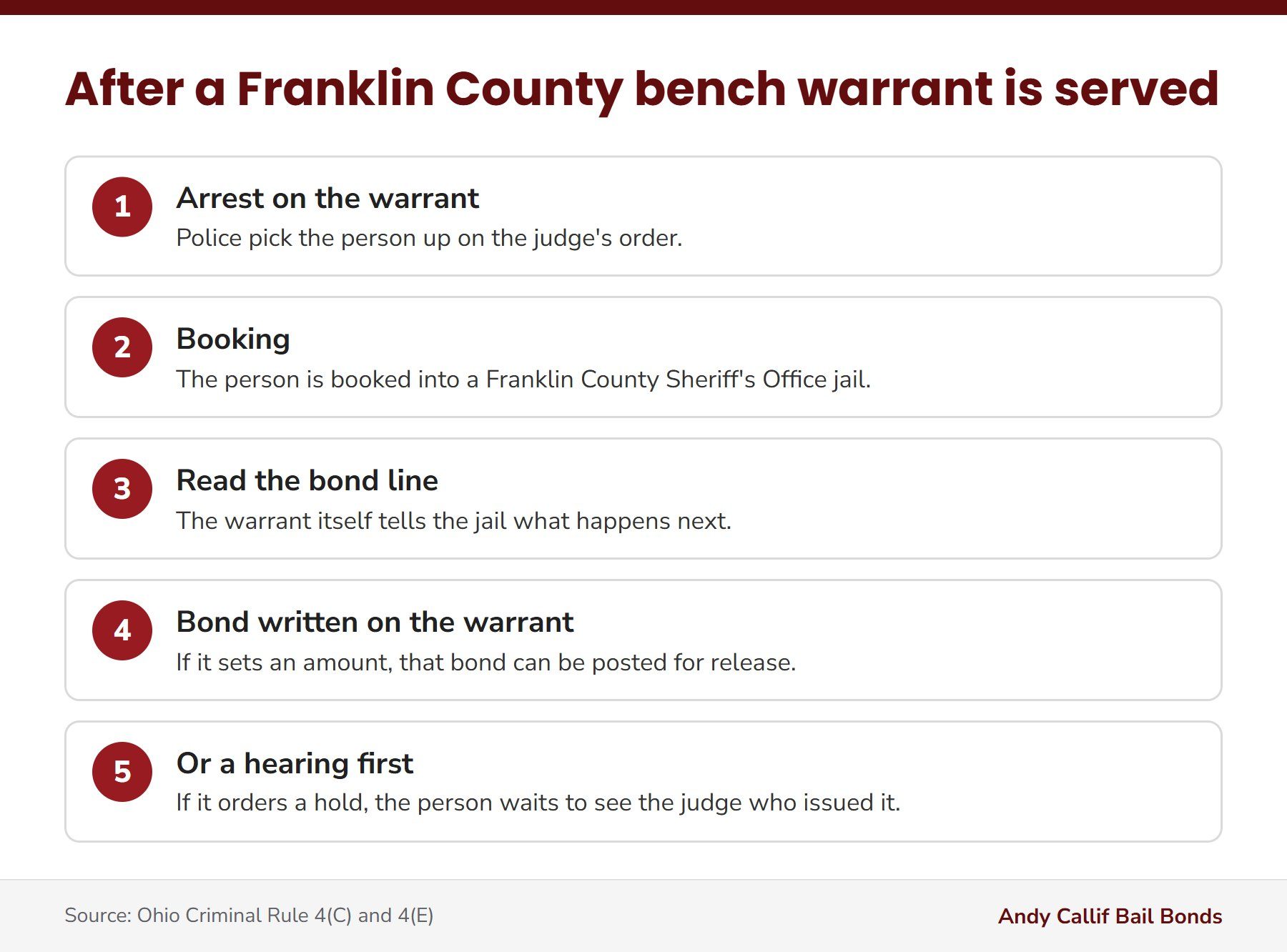
A bench warrant in Columbus is an arrest order from the judge who has the case, usually issued after someone misses a hearing in the Franklin County Municipal Court or in the county’s Court of Common Pleas. The order itself tells the jail what happens next, including whether a bench warrant bail bond in Columbus can be posted right away or the person must wait in custody to see that judge.
Andy Callif Bail Bonds writes bench warrant bail bonds in Columbus for defendants and families across Franklin County. Below you will find why these warrants get issued, how to tell which court is behind yours, how bail is decided after a missed date, and what a bond agent can and cannot do about it.
Why Franklin County judges issue bench warrants
A judge issues a bench warrant when someone does not do what the court ordered. Ohio gives courts this power in R.C. 2937.43: when a released defendant fails to appear, the court with the case may order an arrest, in addition to any other step the law permits.
In Franklin County, these warrants usually follow one of five events:
- Missing an arraignment, pretrial, plea or trial date in a criminal, OVI or traffic case
- Not reporting to jail on the day a sentence was set to start. The Municipal Court Clerk says the Sheriff’s Office reports the no-show and the file goes back to the sentencing judge
- Letting a payment deadline for fines or court costs pass, which puts the case on the Clerk’s weekday enforcement docket for the judge to rule on
- Breaking a condition of probation or another community control sanction, where R.C. 2951.08 allows an arrest on a warrant from the judge who had the case
- Skipping a show-cause hearing or a subpoena in a family case, after which the Domestic Relations and Juvenile Branch can enter an order issuing a capias
Franklin County court papers often say capias where you might expect the words bench warrant. Both describe an order to bring a person before the court. For the basics on how these differ from other arrest warrants, read What Is a Bench Warrant?
Unpaid fines and the ability-to-pay hearing
Owing a fine is not enough, on its own, to keep someone in jail. Under R.C. 2947.14, a court can jail a person for an unpaid fine only after a hearing finds that the person is able to pay and refuses, and each day held is credited at $50 toward the balance. If a payment warrant is the problem, tell the defense attorney about any drop in income before the judge rules.
Which Franklin County court issued your bench warrant
The court behind the warrant decides who can lift it and where the case goes next. Match the case number on your paperwork to the court in this table.
| Court | Cases it hears | Where a warrant question starts |
|---|---|---|
| Franklin County Municipal Court | Misdemeanor, traffic and OVI cases, plus felony initial appearances and preliminary hearings | Your attorney, or a set-aside hearing before the Duty Judge (see below) |
| Franklin County Court of Common Pleas, General Division | Felony cases after a grand jury indictment | Your defense attorney and the judge assigned to the case |
| Court of Common Pleas, Division of Domestic Relations and Juvenile Branch | Family cases, including show-cause hearings on support and custody orders | The attorney on the family case and the court that issued the capias |
| Probation department supervising a community control sanction | Probation violations in a Municipal Court or Common Pleas case | The supervising probation officer and your defense attorney |
Booking, inmate lookup and how the county jail handles release are covered on Franklin County Jail and Courts: How Bail Works.
What does bail cost on a bench warrant in Columbus?
No fixed price exists. Ohio Criminal Rule 4(C)(1)(a) gives a warrant issued after a missed appearance two options: name a cash or secured bond with a new date to return, or order the person held until the issuing court sees them. The judge’s choice between those two is the real answer to the cost question.
When the judge sets or resets the amount, R.C. 2937.011(E) tells the court to consider all relevant information. That includes:
- The person’s record of showing up for court proceedings, or of running to avoid prosecution
- Whether the person was already out on bail, on probation or under community control
- The nature of the charge and the weight of the evidence
- Family ties, employment, finances and length of residence in the community
Because a missed date is part of that record, the bond on a bench warrant can come back higher than the first one. The same factors can also support a lower amount or a recognizance release. The general rules judges use for any bail amount are in How Much Will My Bail Be?
Why the misdemeanor bond schedule may not set the amount
Every Ohio court must maintain a misdemeanor and traffic bail schedule, but R.C. 2937.011(I) limits its purpose to release before the first court appearance and bars the court from treating it as division (E) information. The Franklin County Municipal Court bond schedule presets its highest bond for an unclassified or first-degree misdemeanor, with higher figures for non-residents, and it does not cover domestic violence, protection order violations, sexually oriented offenses or some OVI cases. Once a judge issues a bench warrant, the bond written on it or set at the next hearing is what counts; the chart is a starting point for first releases. Charge-level detail for lower-level cases is on Columbus Misdemeanor Bail Bonds.
Asking for a lower bench warrant bond
If the bond on a bench warrant is more than your family can post, the way to ask for less is a motion to modify bond. The defense attorney files it with the judge who has the case. Because R.C. 2937.011(G) allows the judge to revise the amount or the conditions on either side’s motion, or with no motion at all, the request is handled at a brief hearing or decided on the filings.
What helps: a reason for the missed date with proof, such as hospital papers, a work schedule or a funeral notice; a steady address and job; time lived in Franklin County; a record of making earlier court dates; and a plan for getting to the next one. Coming in on your own instead of waiting to be picked up also counts in your favor.
The judge decides. A bonding office cannot lower a bond, and we do not promise a result. If the amount comes down, we write the bond at the new figure. If it stays where it is, we tell you what it takes to post it.
How a surety bond works on a bench warrant
With a surety bond, a licensed agent guarantees the full amount set on the warrant or by the judge, so the family does not have to deposit it in cash. What you pay the agent is a premium, and R.C. 3905.93 holds a surety to the rate it filed with the state’s Department of Insurance. That premium pays for the guarantee itself, so the family does not get it back when the case closes.
A bail bond agent cannot cancel, recall or lift a bench warrant. Only the court can. Here is what we do once a bond amount exists:
- Go over the warrant details with you or your attorney, so the bond matches the right case number, court and amount
- Have the bond paperwork filled out before a planned surrender, so posting can follow booking
- Post the bond at the Municipal Court Clerk’s Criminal/Traffic Department (375 S. High St., second floor), which takes bail around the clock, every day of the year
- Walk you through the conditions and the new court date that come with release
Phone us any time, day or night. Walk-in hours at the 350 S. High St. office run until 5 p.m. When a bench warrant bond comes up late in the evening, on a weekend or over a holiday, we can book a time for you to come by the office, or we can email the forms and handle the payment by phone, so a trip in is not required.
Bonds are written by Andy Callif (Ohio surety bail bond agent license 594192) through Callif Bonding LLC (license 42586). For his licenses and career history, see the Andy Callif page.
What to have ready for a bench warrant bond
The bond paperwork has to match the court’s record, so gather these before you call:
- The full legal name used on the court case, plus the defendant’s date of birth
- The case number and the court that issued the warrant, from the notice or the court’s online case search
- The bond amount and type listed on the warrant or set by the judge
- Where the person is being held, or the date of a planned surrender
Co-signers on a bench warrant bond show us a government ID and proof that they hold a job. Some bonds need a tax return or a 1099 on top of those.
After bail is posted, the Clerk’s office forwards a release form to the jail. Questions about when the person will actually walk out go to the Franklin County Sheriff’s Office at (614) 525-3368, a line staffed around the clock.
Getting a bench warrant set aside in Franklin County Municipal Court
In the Municipal Court, a request to set aside a warrant goes to the Duty Judge in Courtroom 10C (375 S. High St., 10th floor). Judges take turns in the Duty Room week by week, it sits on weekdays from 8 a.m. to noon and from 1 to 4 p.m., and these hearings are booked through the prosecutors’ office at (614) 645-7483.
- Talk with a defense attorney first. The lawyer can confirm which judge issued the warrant and whether a set-aside request fits the facts.
- Pull together proof of why the date was missed, such as discharge papers from a hospital, a funeral program or a letter from a supervisor.
- Book the hearing through the prosecutors’ office and write down the date and courtroom.
- Tell our office the hearing date, so a bond can be ready if the judge sets a new amount instead of lifting the warrant.
The judge decides whether to set the warrant aside, set a new bond or order the person held, and none of those outcomes is automatic. If a bond needs setting before arraignment, the Clerk lists (614) 645-8449 as the line attorneys use to reach whichever judge is on call. For felony bench warrants from the Court of Common Pleas, ask your defense attorney how the assigned judge handles requests to lift them.
Missed a Franklin County court date? Get in touch with our office immediately. We can contact your public defender, and sometimes the court, about putting a new date on the calendar. Do not go into hiding over it; every day you wait narrows what we can do.
To check for an open warrant or plan a surrender with the bond ready, see Columbus Warrant Bail Bonds. Options that may avoid a jail stay are covered in How Do You Take Care of a Warrant Without Going to Jail?
What a bench warrant does to the first bond
A missed date also puts the original bail at risk. Under R.C. 2937.35, the court can declare it forfeited in whole or in part, or pick a later date and give notice to the defendant and the sureties before acting.
People released on their own recognizance face one more risk. R.C. 2937.99 makes failing to appear a separate crime for them: a fourth-degree felony when the underlying case is a felony, and a first-degree misdemeanor when it is a misdemeanor. Most traffic cases are excluded, but OVI and leaving the scene of a crash are not.
For the forfeiture timeline and what a missed date means for a co-signer, read What Happens If You Miss Court While Out on Bail?
How to keep the next court date after a bench warrant
After a bench warrant bond is posted, the new date counts for more than the old one, because a second miss adds to the appearance record the judge reviews. A few habits help:
- Sign up for court texts. The Municipal Court’s text reminder form allows up to two messages per hearing, carrier rates may apply, and texting STOP to 48020 ends them
- Treat the texts as a backup, since the form warns that messages are not guaranteed to arrive
- Keep the bond receipt, the courtroom number and the new date in one place, and share a copy with the co-signer
- About two or three days after posting, phone us for the new court date, then check in again ahead of every later hearing; one case can carry several dates, and court mail often arrives late
- If a conflict comes up, call the attorney before the hearing, not after it
Ohio’s eWarrants system, run by the Ohio Department of Public Safety, makes warrants visible to agencies statewide in real time. A second bench warrant can surface at any traffic stop, anywhere in Ohio.
Talk to us about a bench warrant
If a Franklin County judge has issued a bench warrant for you or someone in your family, Andy Callif Bail Bonds can look over the warrant details and have a bond ready around the set-aside hearing or the surrender. Reach us day or night at (614) 221-0100, or send a message through our contact us page. Facing a different charge in Franklin County? See Columbus Bail Bonds in Franklin County.
Andy Callif Bail Bonds (Callif Bonding LLC), 350 S. High St., Columbus, OH 43215
This page shares general information and is not legal advice; an Ohio criminal defense attorney can advise you on your own case.
Frequently asked questions
What does bail cost on a bench warrant in Columbus?
It depends on the warrant. One issued after a missed date either names a cash or secured bond or orders the person held until the judge sees them. When the judge sets the amount, Ohio law lists the person’s record of appearing in court as one of the factors.
Can you bond out on a bench warrant?
Often, yes. When a bond amount appears on the warrant, it can be posted after booking, and the person leaves with a new date to return. If the warrant says no bail, the person remains in jail until the issuing court sees them.
Can a bail bondsman get a bench warrant lifted?
No. Only the court can set a bench warrant aside. A defense attorney asks the judge to lift it, and a bail bond agent can post whatever bond the warrant or the judge sets.
How long can you be held on a bench warrant in Franklin County?
There is no fixed length. Ohio Criminal Rule 4 says a person who is not released on the warrant’s bond must go before the court that issued it without unnecessary delay. Once a bond is posted, the Franklin County Sheriff’s Office handles the physical release from jail.
Does a bench warrant expire in Ohio?
No. A bench warrant remains in force until police serve it or the judge lifts it. Ohio’s eWarrants system shows warrants to agencies around the state in real time, so moving to another county does not make one go away.
What is a capias in Franklin County?
A capias is a court order directing officers to arrest a person and deliver that person to court. Franklin County courts use the word for orders issued after a missed hearing, including family cases where someone skipped a show-cause hearing or a subpoena.
Is a bench warrant a new criminal charge?
The warrant is an order to arrest, not a charge, and the original case stays open. Under Ohio law, someone who was out on their own recognizance and then misses court can be prosecuted for that failure to appear as a separate offense.
What happens if you ignore a bench warrant?
The warrant stays open, and any police contact can end in an arrest. Ignoring it can also count against the person later: a judge setting bail weighs the record of appearing in court, the first bond can be forfeited, and a person out on recognizance risks a second, separate charge for failing to appear.