
By Andy Callif, licensed Ohio surety bail bond agent (license 594192; Callif Bonding LLC license 42586). Reviewed November 2026.
Common reasons to go to jail in Ohio include arrests for OVI, theft, drug possession, assault, domestic violence and disorderly conduct, along with warrants for missed court dates and probation violations. Most of these start as misdemeanors and are served in a county jail; a felony conviction can mean a state prison instead.
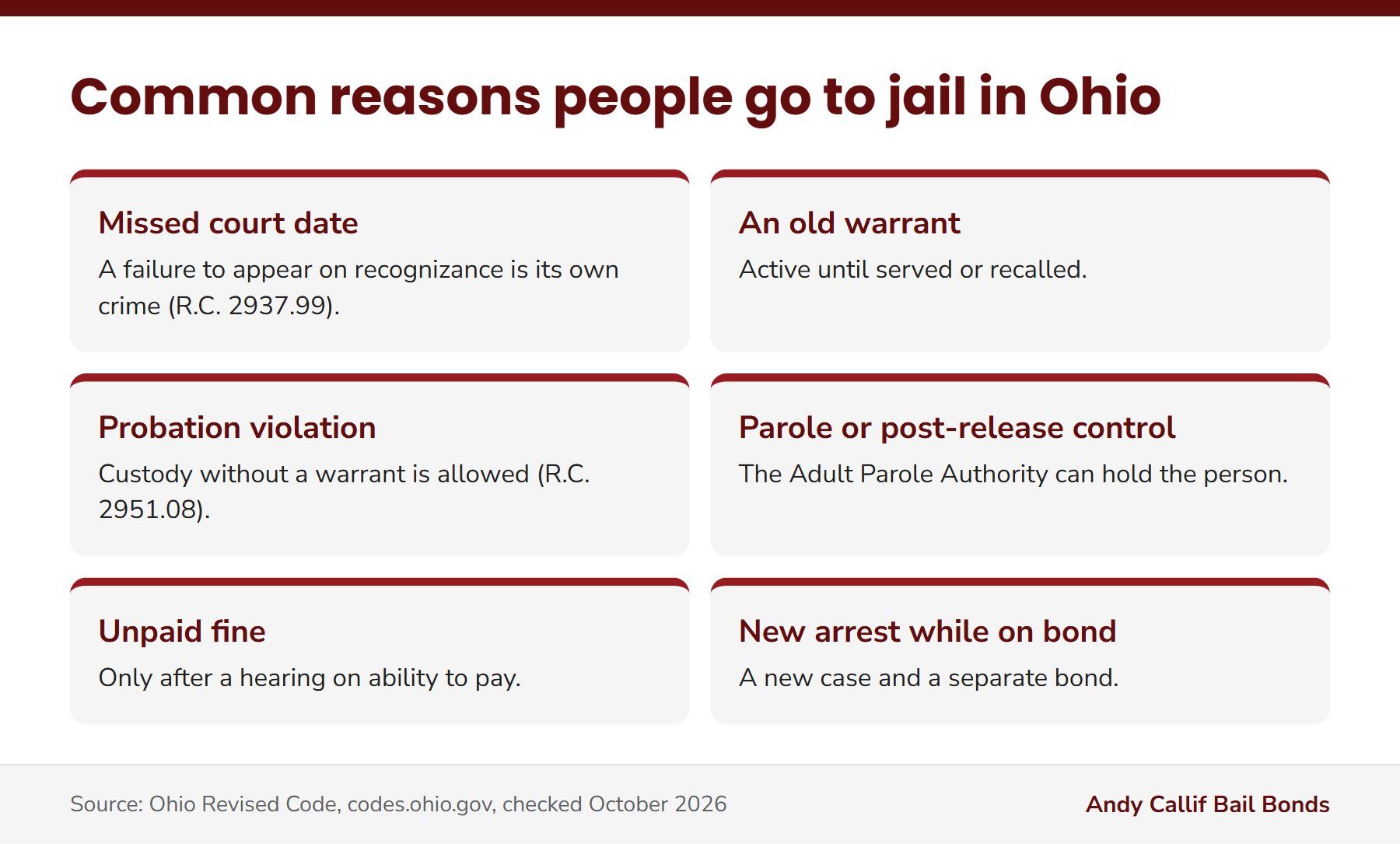
We put this list together at Andy Callif Bail Bonds for people looking at a loved one’s jail listing and trying to understand the charge. Each reason below names the Ohio Revised Code (R.C.) section behind it and the level where the charge usually starts. An arrest is an accusation, not a finding of guilt, and nothing here assumes otherwise.
Common reasons to go to jail in Ohio at a glance
The table sorts charges and holds that commonly bring someone into an Ohio jail by the statute that creates each one and the level it usually starts at. A prior record, the dollar value involved or an injury can move a charge up a level.
| Reason | Ohio law | Usual starting level | Where a sentence is served |
|---|---|---|---|
| OVI (impaired driving) | R.C. 4511.19 | First-degree misdemeanor for a first offense in 10 years | Jail, with a 3-day mandatory term the court may trade for an intervention program |
| Theft, including shoplifting | R.C. 2913.02 | First-degree misdemeanor below $1,000; a felony from $1,000 up | Jail on a misdemeanor; prison is possible on felony theft |
| Drug possession | R.C. 2925.11 | Varies by drug and amount, from a first-degree misdemeanor to a felony | Jail or prison, by level |
| Assault | R.C. 2903.13 | First-degree misdemeanor | Jail |
| Domestic violence | R.C. 2919.25 | Misdemeanor on a first offense; a felony after a prior conviction | Jail, or prison on a felony |
| Disorderly conduct | R.C. 2917.11 | Minor misdemeanor; fourth-degree misdemeanor after a warning | No jail at the minor level |
| Driving under suspension | R.C. 4510.11 | First-degree misdemeanor | Jail |
| Missed court after a recognizance release | R.C. 2937.99 | First-degree misdemeanor; fourth-degree felony when the underlying charge is a felony | Jail or prison |
| Probation (community control) violation | R.C. 2951.08 | Not a new charge; a hold until the judge reviews it | Decided by the sentencing judge |
Source: Ohio Revised Code sections as posted on codes.ohio.gov, read October 18, 2026. For the jail term and fine at each misdemeanor level, see Ohio Misdemeanor Degrees: Penalties and What Bond to Expect. The five felony levels are laid out in Ohio Felony Degrees (F1 to F5): Penalties and What Bond to Expect.
What are some common reasons people end up in jail in Ohio?
Many bookings begin with an ordinary moment that goes wrong: a traffic stop, an argument at home, a call from a store’s security staff. Here is how Ohio law treats the charges that can follow.
Operating a vehicle under the influence (OVI)
Ohio’s name for drunk or drugged driving is OVI. Under R.C. 4511.19, the charge covers a driver impaired by alcohol, a drug of abuse or a combination of the two, or one who tests at or over a per se limit, which starts at 0.08% blood alcohol. A low reading does not rule out a charge when an officer sees impairment.
OVI is a first-degree misdemeanor the first time within 10 years, and the statute calls for three consecutive days in jail, which the judge may suspend in favor of a drivers’ intervention program. Depending on the court and the facts, a person charged with OVI may go home on recognizance or a scheduled bond, or may have to wait for a judge.
Drug-related offenses
Ohio’s possession law, R.C. 2925.11, bars knowingly getting, having or using a controlled substance. The level turns on the drug and the amount. With Schedule III, IV and V drugs, having less than the bulk amount is a first-degree misdemeanor for someone with no prior drug offense, while possession of even a small amount of cocaine is a fifth-degree felony. Selling or trafficking is a separate offense under R.C. 2925.03.
Substance use is often a health problem as much as a legal one. Ask the defense attorney whether a treatment-based option, such as intervention in lieu of conviction under R.C. 2951.041, fits the charge.
Theft
Theft under R.C. 2913.02 covers shoplifting, taking a vehicle and obtaining property or services by deception. The value decides the level: under $1,000 is misdemeanor theft, a first-degree misdemeanor punishable by as much as 180 days in jail under R.C. 2929.24, and $1,000 or more is a felony.
Theft cases often hinge on facts that can be disputed, such as who owned an item, whether someone had permission to use a card or account, or what a witness thinks they saw. Those details are for the defense attorney to sort out.
Assault and violent crimes
Ohio’s basic assault statute, R.C. 2903.13, makes it a crime to knowingly cause or try to cause physical harm to another person or another’s unborn, or to recklessly cause serious physical harm. Basic assault is a first-degree misdemeanor. Aggravated assault and felonious assault are felonies.
Intent to hurt someone is not always required. Hurting a person through carelessness with a gun or other deadly weapon is negligent assault, a third-degree misdemeanor under R.C. 2903.14. People who stepped in to break up a fight or were protecting themselves are sometimes charged as well, and self-defense is something to raise with a lawyer.
Domestic violence
Domestic violence under R.C. 2919.25 means causing, or attempting to cause, physical harm to a person who is a family or household member, or making that person believe harm is about to happen through a threat of force. A first offense involving harm is a first-degree misdemeanor, a threat is a fourth-degree misdemeanor, and a prior conviction can turn the harm charge into a felony.
Police answering these calls are expected to make an arrest. Ohio law states that arrest is the preferred course of action when an officer has reasonable grounds to believe domestic violence took place (R.C. 2935.03(B)(3)(b)). Many courts also hold these charges for a judge instead of using a bond schedule.
Disorderly conduct
Disorderly conduct, R.C. 2917.11, is recklessly causing inconvenience, annoyance or alarm by acts such as fighting, loud noise, insults likely to provoke violence or blocking people’s way. On its own it is a minor misdemeanor with no jail term. It becomes a fourth-degree misdemeanor when the person keeps it up after a reasonable warning or request to stop, which is how refusing an officer’s instruction can turn a ticket into an arrest.
Driving under suspension
Driving while a license is suspended is a first-degree misdemeanor under R.C. 4510.11. Some people find out about the suspension only at a traffic stop, for example when a court suspended the license over a missed date in a traffic case (R.C. 4510.22).
Other reasons people get arrested and held in jail
A jail stay does not always start with a new crime. An older case, or the rules of a past sentence, can put someone in custody too, and the family may hear about it only when the booking appears.
- A missed court date. The judge can issue a warrant. For a person released on recognizance, failing to appear is a separate crime under R.C. 2937.99: a first-degree misdemeanor if the original charge was a misdemeanor, or a fourth-degree felony if it was a felony. See What Happens If You Miss Court While Out on Bail?
- An old warrant. A warrant from a past case stays active until it is served or recalled. What Is a Bench Warrant? explains how one is issued and cleared.
- A probation violation. Someone on community control can be taken into custody by a probation officer without a warrant, and by police who have reasonable ground to believe the person broke certain conditions, such as a no-contact order or drug testing. The person then goes before the judge or magistrate on the case (R.C. 2951.08).
- Violating parole or post-release control. The Adult Parole Authority can have the person held in the county jail of the arrest, or another facility it names, while it decides on release status (R.C. 2967.15).
- An unpaid fine. A court may order jail over a fine only after a hearing finds the person able to pay and refusing to. The stay cannot run past six months, and each day counts as $50 toward the fine (R.C. 2947.14).
- A new arrest while out on bond. A second case and a separate bond come with the new charge, and the first judge may take another look at the original release. What Happens If Bail Gets Revoked? covers that step.
What is the difference between jail and prison in Ohio?
A jail in Ohio is a local facility run by a county or city that holds people waiting on court and people serving misdemeanor sentences. A prison is a state institution run by the Ohio Department of Rehabilitation and Correction (ODRC) for people serving felony sentences. Who runs it, who is inside and how long they stay are the main differences.
| Question | Jail | Prison |
|---|---|---|
| Who runs it | A county, a city or a group of them; the sheriff has charge of the county jail (R.C. 341.01) | The ODRC for state prisons (R.C. 5120.05); the Federal Bureau of Prisons for federal ones |
| Who is held | People awaiting a bail decision or trial, and people serving misdemeanor jail terms | People serving felony prison terms (R.C. 2929.34(B)) |
| How long | Up to 180 days for one misdemeanor (R.C. 2929.24); back-to-back misdemeanor terms cannot pass 18 months in total (R.C. 2929.41(B)(1)) | From 6 months for the lowest felony to minimum terms of up to 11 years for the most serious, and longer for murder (R.C. 2929.14) |
| Turnover | High, because people leave once they post bond or finish short terms | Lower, because sentences run months or years |
| Programs | Varies by county or city. The sheriff or city that runs the jail decides what it offers, and short stays limit it, so check the jail’s own site | Statewide ODRC programming: academic and vocational education through the Ohio Central School System, medical and behavioral health care, recovery services run with the Ohio Department of Behavioral Health, and reentry and transitional control programs before release (drc.ohio.gov) |
| Columbus example | The Franklin County Sheriff’s Office runs the James A. Karnes Corrections Center and Corrections Center II on Jackson Pike | ODRC institutions around the state |
The legal definitions match this split. R.C. 2929.01 defines a jail as a facility operated by a political subdivision of the state, and a prison as a facility for convicted felony offenders under ODRC control. The Franklin County Sheriff’s Office lists both of its corrections centers on its Corrections Division page.
Can a felony sentence be served in jail in Ohio?
Yes, in some cases. When a judge sentences a felony to community control instead of prison, one option is up to six months in a jail (R.C. 2929.16(A)(2)). In counties that take part in Ohio’s targeted community alternatives to prison program, people sentenced to prison for many nonviolent fifth-degree felonies, and since September 1, 2022 some fourth-degree felonies, serve that time locally rather than in a state prison (R.C. 2929.34(B)(3)).
That program leaves out offenses of violence, sex offenses, drug trafficking under R.C. 2925.03 and charges that carry a mandatory prison term, among other exclusions.
Where someone arrested in Columbus is held
An arrest in Columbus or elsewhere in Franklin County usually ends with a booking into a Franklin County Sheriff’s Office jail, not a prison. Franklin County Jail and Courts: How Bail Works covers the jail, the courts that set bond and where to post it.
What happens after someone goes to jail
Once a booking shows up, the next questions are where the person is held and whether bail has been set. These guides take each step in order:
- Finding the person: How Do I Find a Loved One After an Arrest?
- Checking whether the charge allows bail: What Crimes Are Bailable in Ohio?
- Bail on a misdemeanor: How Much Is Bail for a Misdemeanor in Ohio?
- Bail on a felony: What to Know About Bail for Felonies in Ohio
- Posting the bond: How Do I Bail Someone Out of Jail in Ohio?
- Release terms once bail is set: What Are the Conditions of Bail?
Whatever the charge, call our office before anything else, and I will explain the next step. In Franklin County, a misdemeanor such as a theft or traffic case carries a preset bond that can be posted before any judge looks at the case. A domestic violence felony works differently: that person sees the judge in Courtroom 4D the next day at 9 a.m.
Protecting yourself after an arrest in Ohio
You have the right to stay silent when police ask about a crime, under the Fifth Amendment to the U.S. Constitution and Article I, Section 10 of the Ohio Constitution. Ask for a lawyer before you answer questions, even if you believe you did nothing wrong. Ohio law also requires that someone in custody be given a prompt way to reach an attorney (R.C. 2935.20).
- Save the facts of the case for your lawyer, and assume calls from the jail are recorded.
- Stay off text, email and social media about the arrest; those messages can become evidence.
- Do not argue with officers at the scene. A disagreement can be taken up in court later.
- Write down the booking number, any case number and the next court date.
Seek help after an arrest with Andy Callif Bail Bonds
Whatever the reason someone went to jail, the next step is the same: learn where bail stands. Read us the charge and the booking number, and we can tell you whether a bond has been set and what a surety bond would involve. Calls to (614) 221-0100 are answered 24/7, and the contact page takes written questions.
Andy Callif Bail Bonds (Callif Bonding LLC), 350 S. High St., Columbus, OH 43215
This guide explains Ohio law in general terms. It is not legal advice; an Ohio criminal defense attorney can tell you how it applies to a specific case.
Frequently asked questions
What is the most common reason people go to jail?
No official statewide ranking of Ohio jail bookings was available for this guide. Charges that commonly lead to a booking include OVI, theft, drug possession, assault and domestic violence. People are also held on warrants for missed court dates or on probation violations rather than new charges.
What is the difference between jail and prison?
A jail is local and short-term: counties and cities run jails for people awaiting court and people serving misdemeanor sentences. A prison is run by the state, through the Ohio Department of Rehabilitation and Correction, for people serving felony sentences.
Is 60 days in jail or prison?
Jail. In Ohio, misdemeanor terms are served in a county or municipal jail, and 60 days is the longest term for a third-degree misdemeanor. Prison terms are for felonies and start at six months.
Can you go to jail for a first OVI in Ohio?
Yes. A first OVI in 10 years is a first-degree misdemeanor, and R.C. 4511.19 requires three consecutive days in jail, which the court can replace with a drivers’ intervention program.
Who runs jails and prisons in Ohio?
County sheriffs run county jails, and some cities run their own jails or workhouses. The Ohio Department of Rehabilitation and Correction runs the state prisons, and the Federal Bureau of Prisons runs federal ones.
Can you go to jail for not paying a fine in Ohio?
Only after a hearing. Under R.C. 2947.14, a court can jail someone over an unpaid fine only if it finds the person able to pay and refusing, the stay is capped at six months, and each day is credited as $50 toward the fine.
Can you go to jail for a minor misdemeanor in Ohio?
No. A minor misdemeanor, such as basic disorderly conduct, has no jail term. Police usually write a citation, but ignoring it or missing the court date can lead to a warrant for the person’s arrest.
Can you go to jail for unpaid child support in Ohio?
Yes. Failing to provide adequate or court-ordered support for a child is nonsupport of dependents under R.C. 2919.21, a first-degree misdemeanor. It becomes a fifth-degree felony after a prior conviction, or when support went unpaid for a total of 26 weeks out of 104 in a row. Paying what you could while being unable to pay the full amount is a defense.