
By Andy Callif, licensed Ohio surety bail bond agent (license 594192; Callif Bonding LLC license 42586). Reviewed November 2026.
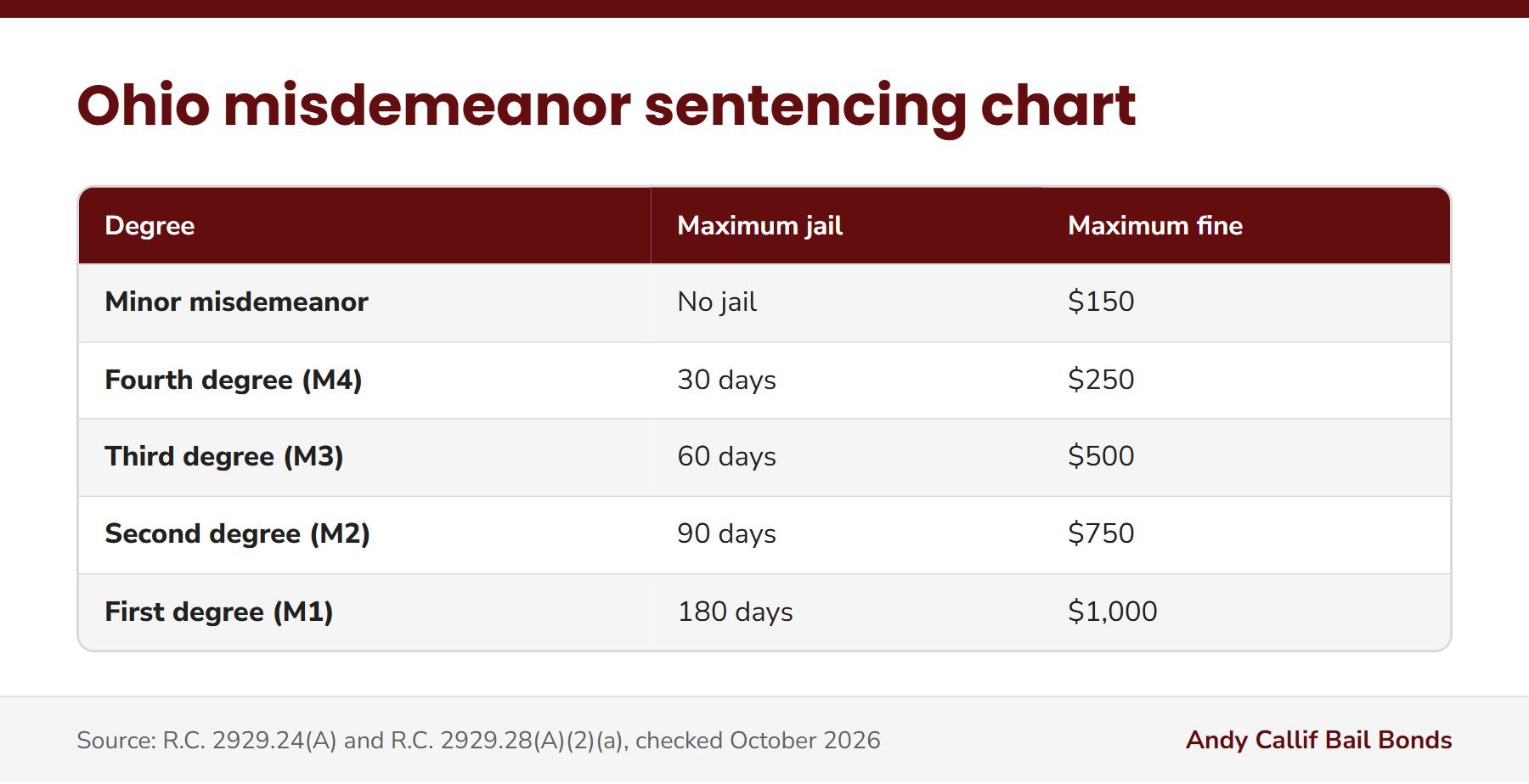
Ohio has five misdemeanor levels. A first degree misdemeanor in Ohio is the most serious, with jail of up to 180 days and a fine of up to $1,000. Second, third and fourth degree charges top out at 90, 60 and 30 days, and a minor misdemeanor brings a fine of no more than $150 and no jail.
Below, each degree gets its own section: the statute behind the penalty, charges the Revised Code places at that level, and what bond looks like in the municipal courts of our two office counties, Franklin County’s in Columbus and Delaware’s. This guide comes from Andy Callif Bail Bonds, written for central Ohio families seeing a charge sheet for the first time. Every penalty here is taken from the statute and cited so you can check it; how the law fits one person’s case is a question for an Ohio criminal defense attorney.
Ohio misdemeanor sentencing chart
The chart pulls the general limits from three statutes: jail terms from R.C. 2929.24(A), fines from R.C. 2929.28(A)(2)(a) and the time the state has to bring charges from R.C. 2901.13(A)(1).
| Degree | Jail, up to | Fine, up to | Time to file charges | Examples |
|---|---|---|---|---|
| First degree (M1, 1st degree) | 180 days | $1,000 | 2 years | Theft under $1,000, assault, a first OVI |
| Second degree (M2, 2nd degree) | 90 days | $750 | 2 years | Criminal damaging, obstructing official business |
| Third degree (M3, 3rd degree) | 60 days | $500 | 2 years | Negligent assault, unlawful restraint |
| Fourth degree (M4) | 30 days | $250 | 2 years | Criminal trespass, menacing |
| Minor misdemeanor | No jail | $150 | 6 months | Disorderly conduct, an open container |
The jail figure is the longest term the law allows. Under R.C. 2929.22(A), a judge sentencing a misdemeanor can pick any sanction, or mix of sanctions, that R.C. 2929.24 to 2929.28 allow, including jail, community control or a fine on its own. The law that creates an offense can also write its own penalty, as the section on sentences beyond the chart explains. A conviction at any of these levels also shows on the background checks employers and landlords run until the record is sealed under R.C. 2953.32.
How misdemeanor bond is set in Columbus and Delaware
In both counties, the first bond on most misdemeanors comes from a court-written schedule rather than a hearing. R.C. 2937.011(I) makes every Ohio court adopt one, and both local municipal courts post theirs online. The degree is one input. Where the person lives and which charge was filed count just as much.
Franklin County Municipal Court (Columbus and the rest of Franklin County)
Most misdemeanors in this court carry a bond preset by its schedule. The amount climbs with the degree of the charge, and someone who lives outside Ohio owes more unless they show the clerk proof of a job or school enrollment in Ohio. Ask us for the figure on a specific charge.
In my experience, a Franklin County misdemeanor such as a theft or traffic charge has a preset bond, so it can go up without a wait for a judge.
The court keeps these cases off the schedule entirely, so bond waits for the judge at the in-custody arraignment in Courtroom 4D:
- Domestic violence, assault and the menacing offenses, along with a protection order violation
- Endangering children, riot, escape and intimidation of a witness or crime victim
- Criminal damaging or criminal mischief where a family or household member is the alleged victim
- OVI charged under R.C. 4511.19(G)(1)(c) or (d)
- A case that pairs a misdemeanor with a felony, a hold for a probation violation, and a warrant on which a judge already wrote a bond
Delaware Municipal Court (Delaware County)
Delaware’s bail bond schedule, effective May 20, 2024, sorts people by home address before it looks at the degree. Delaware County residents sign a personal recognizance bond for any degree unless the charge is one the schedule reserves for a judge. Ohio residents from other counties and people from out of state post a money bond set by degree, plus a court fee. Rule 2.04 of the court’s local rules, effective January 1, 2026, lets someone be released under that schedule by the clerk, the jail commander or the arresting agency.
Delaware’s reserved list overlaps the Columbus one: assault, domestic violence and the other offenses against a person wait for a judge, and so do a third lifetime OVI and several other driving charges. The jail commander may also hold a person whose charge is on the schedule, for example someone already on probation or with a history of missed court dates.
Treat both schedules as starting points. A judge can order a different bond at any stage. How Much Is Bail for a Misdemeanor in Ohio? covers what each kind of bond costs to post and lines these two schedules up against a third Ohio court.
First degree misdemeanor in Ohio (M1)
The M1 is the highest misdemeanor level. R.C. 2929.24(A)(1) allows a jail term of up to 180 days, and R.C. 2929.28 allows a fine of up to $1,000.
Charges the Revised Code makes an M1
- Theft of property worth less than $1,000, often called petty theft, unless the type of property or the person’s record raises the level (R.C. 2913.02)
- Assault: knowingly causing physical harm to another person, or attempting to (R.C. 2903.13)
- Domestic violence that causes or attempts physical harm, on a first offense (R.C. 2919.25)
- OVI with no prior OVI in the last ten years (R.C. 4511.19)
- Driving under suspension, at any offense count (R.C. 4510.11)
- Criminal damaging that creates a risk of physical harm to someone (R.C. 2909.06)
- Resisting arrest that causes physical harm to a law enforcement officer (R.C. 2921.33)
Penalties beyond jail and a fine on some M1 charges
- OVI: a first offense also suspends the driver’s license for one to three years, though the court can allow limited driving privileges (R.C. 4511.19(G)(1)(a)(iv)).
- Driving under suspension: when the vehicle is registered to the driver, one prior violation within three years lets the court order 30 days of vehicle immobilization and plate impoundment, two priors raise that to 60 days, and three or more allow criminal forfeiture of the vehicle (R.C. 4510.11).
What bond to expect on an M1
- Franklin County Municipal Court: an M1 carries the highest preset bond on the court’s schedule, with a larger figure for someone from outside Ohio; we can give you the amount by phone. Assault and domestic violence skip the schedule and go to Courtroom 4D.
- Delaware Municipal Court: recognizance for Delaware County residents, $2,500 for other Ohio residents and $5,000 for out-of-state residents. Assault, domestic violence and menacing by stalking wait for a judge.
Second degree misdemeanor in Ohio (M2 or 2nd degree)
An M2 can bring up to 90 days in jail and a fine of up to $750. Most of the examples below involve property damage or interfering with police and public officials.
Charges the Revised Code makes an M2
- Criminal damaging or endangering in its basic form, with no risk of physical harm to a person (R.C. 2909.06)
- Obstructing official business (R.C. 2921.31)
- Resisting arrest, done recklessly or by force (R.C. 2921.33(A))
- Dealing in drug paraphernalia, unless the buyer is a juvenile (R.C. 2925.14)
- Abuse of a corpse under division (A) (R.C. 2927.01)
What bond to expect on an M2
- Franklin County Municipal Court: a preset bond one step below the M1 amount, and more for a nonresident (see the court section above).
- Delaware Municipal Court: recognizance for county residents, $2,000 for other Ohio residents and $3,500 for out-of-state residents.
Third degree misdemeanor in Ohio (M3 or 3rd degree misdemeanor)
An M3 allows up to 60 days in jail and a fine of up to $500. Some offenses reach this level only through prior convictions or the way the act was done, as the reckless operation entry shows.
Charges the Revised Code makes an M3
- Negligent assault: causing physical harm with a deadly weapon through negligence (R.C. 2903.14)
- Unlawful restraint (R.C. 2905.03)
- Public indecency under R.C. 2907.09(A)(2) or (A)(3), on a first offense (R.C. 2907.09)
- Reckless operation of a vehicle by a driver with two or more traffic convictions in the past year (R.C. 4511.20)
What bond to expect on an M3
- Franklin County Municipal Court: the scheduled bond drops again from the M2 level, with a higher figure for people who live out of state (see the court section above).
- Delaware Municipal Court: recognizance for county residents, $1,500 for other Ohio residents and $3,000 for out-of-state residents.
Fourth degree misdemeanor in Ohio (M4)
What is a 4th degree misdemeanor in Ohio? It is the lowest level that still carries jail: up to 30 days, with a fine of up to $250.
Charges the Revised Code makes an M4
- Criminal trespass (R.C. 2911.21)
- Menacing, in its basic form (R.C. 2903.22)
- Domestic violence by threat under R.C. 2919.25(C), on a first offense
- Illegal use or possession of drug paraphernalia, except paraphernalia used for marijuana (R.C. 2925.14)
- Disorderly conduct that continues after a warning to stop (R.C. 2917.11)
- Drinking beer or liquor in a motor vehicle (R.C. 4301.64; penalty in R.C. 4301.99)
- Public indecency under R.C. 2907.09(A)(1), on a first offense
- Reckless operation by a driver with one traffic conviction in the past year (R.C. 4511.20)
What bond to expect on an M4
- Franklin County Municipal Court: the smallest preset bond for a charge that can still bring jail, raised for nonresidents (see the court section above). Menacing and domestic violence by threat still go to the 4D judge.
- Delaware Municipal Court: the M4 amount matches the M3 amount, $1,500 for other Ohio residents and $3,000 for out-of-state residents, with recognizance for county residents. Domestic violence waits for a judge.
Minor misdemeanor in Ohio
A minor misdemeanor in Ohio carries no jail at all. Under R.C. 2901.02(G), the only penalties allowed are a fine capped at $150, community service, or a financial sanction other than a fine. It is still an offense under the Revised Code, not a civil ticket, and the state has six months to file it.
Charges the Revised Code makes a minor misdemeanor
- Disorderly conduct in its basic form (R.C. 2917.11)
- Reckless operation by a driver with no traffic conviction in the past year (R.C. 4511.20)
- Having an open container of beer or liquor where the law bars it (R.C. 4301.62; penalty in R.C. 4301.99)
What bond to expect on a minor misdemeanor
Usually none. R.C. 2935.26 generally calls for a citation instead of an arrest. If someone is held anyway, Franklin County Municipal Court presets a bond for it, and Delaware’s schedule calls for a citation, not a bond.
What can push a misdemeanor sentence past the chart
The chart shows the general limits. Four rules can change the picture for a specific case:
- The offense’s own statute. A first OVI requires at least three consecutive days in jail, or in some cases a three-day drivers’ intervention program, and a fine of $565 to $1,075, which runs past the general M1 fine cap (R.C. 4511.19(G)(1)(a)).
- Back-to-back jail terms. A judge can order misdemeanor jail terms served consecutively, but the total cannot pass 18 months (R.C. 2929.41(B)(1)).
- Community control. Ohio’s version of probation can run alongside a jail term or replace it, for up to five years in total (R.C. 2929.25).
- Sentencing factors. R.C. 2929.22(B) has the judge weigh the facts of the offense, the person’s history and risk of reoffending, danger to others, how vulnerable the victim was, and military service.
How Ohio decides which misdemeanor degree a charge is
The statute that defines an offense names its degree. Many of those statutes then move the degree with the facts: the value involved, a prior conviction or the way the harm happened.
- Reckless operation: a minor misdemeanor for a first offense, an M4 after one traffic conviction within a year, and an M3 after two or more.
- Domestic violence: an M4 for a threat and an M1 for physical harm on a first offense. Prior convictions or a known pregnancy can raise either one, up to a felony.
- Criminal damaging: an M2 for property damage alone and an M1 once the act puts a person at risk of physical harm.
Unclassified misdemeanors
When a law sets a penalty but names no degree, R.C. 2901.02(F) treats the offense as a misdemeanor if the possible jail term is one year or less. Division (G) makes it a minor misdemeanor when nothing beyond a $150 fine, community service or a non-fine financial sanction can be imposed.
When a misdemeanor charge becomes a felony
The facts of a case can also turn the same conduct into a felony. Theft becomes a felony once the value reaches $1,000, and vandalism under R.C. 2909.05 is a felony from its lowest level, while criminal damaging stays a misdemeanor. Ohio Felony Degrees (F1 to F5): Penalties and What Bond to Expect covers the five felony levels in the same format, and What Crimes Are Bailable in Ohio? explains why every misdemeanor qualifies for bail.
Misdemeanor bail bonds in the counties we serve
Each county’s courts, jail and bond steps are on its own misdemeanor page:
- Franklin County: Columbus Misdemeanor Bail Bonds
- Delaware County: Delaware, OH Misdemeanor Bail Bonds
- Fairfield County: Lancaster, OH Misdemeanor Bail Bonds
- Licking County: Newark, OH Misdemeanor Bail Bonds
- Ross County: Chillicothe, OH Misdemeanor Bail Bonds
- Pickaway County: Circleville, OH Misdemeanor Bail Bonds
The six counties above are not the only places we work: our Columbus office serves all of greater Columbus, our Delaware office covers greater Delaware, Ohio, and we take calls from other Ohio counties by phone.
Questions about Ohio misdemeanor degrees and bond? Call us
Read us the charge, its degree and the court from the booking record, and we will tell you which schedule applies and whether a judge still has to set the bond. Call (614) 221-0100 at any hour to reach Andy Callif Bail Bonds, a business family owned and operated since 1960 that has 900+ Google reviews. If writing is easier, the contact page reaches us too.
Andy Callif Bail Bonds (Callif Bonding LLC), 350 S. High St., Columbus, OH 43215
We drew these penalty ranges from the Revised Code for reference only; they are not legal advice. For how they fit a specific charge, speak with a defense lawyer licensed in Ohio.
Frequently asked questions
What is a first degree misdemeanor in Ohio?
It is Ohio’s most serious misdemeanor level, often written M1. R.C. 2929.24 caps the jail term at 180 days and R.C. 2929.28 caps the fine at $1,000. Theft under $1,000, assault, a first OVI and driving under suspension are common M1 charges.
Which is worse, an M1 or an M4?
An M1. Ohio numbers its misdemeanors so the first degree is the most serious and the fourth degree is the least serious level that can still bring jail. An M1 can mean 180 days and $1,000; an M4, 30 days and $250.
Can you go to jail for a fourth degree misdemeanor in Ohio?
Yes, for up to 30 days. Jail is possible at every level from M4 through M1. Only a minor misdemeanor has no jail term.
What is the lowest misdemeanor in Ohio, and how serious is it?
The minor misdemeanor. It carries no jail; the court can impose a fine capped at $150, community service or a non-fine financial sanction. In most cases the officer hands the person a citation and does not take them to jail.
Does Ohio have class A or class B misdemeanors?
No. Ohio grades misdemeanors by degree, first through fourth, plus the minor misdemeanor. The first degree is Ohio’s top misdemeanor tier, the level some other states label class A.
How long does the state have to file a misdemeanor charge in Ohio?
Under R.C. 2901.13, the general limit is two years for a misdemeanor and six months for a minor misdemeanor. The statute has exceptions that can extend the period.
How much is a misdemeanor bond in Columbus?
Most Columbus misdemeanors carry a preset bond from the Franklin County Municipal Court’s schedule, and posting it usually does not hinge on a judge. The amount rises with the degree, and we will tell you the figure when you call. Domestic violence, assault and some other charges wait for a judge.
Can a misdemeanor be sealed in Ohio?
Many can. Until then, the conviction appears on employment, housing and licensing background checks. R.C. 2953.32 lets a person apply to seal most misdemeanor conviction records one year after final discharge, or six months after for a minor misdemeanor. Traffic-chapter convictions such as OVI, and first- or second-degree domestic violence convictions, are left out.