
By Andy Callif, licensed Ohio surety bail bond agent (license 594192; Callif Bonding LLC license 42586). Reviewed November 2026.
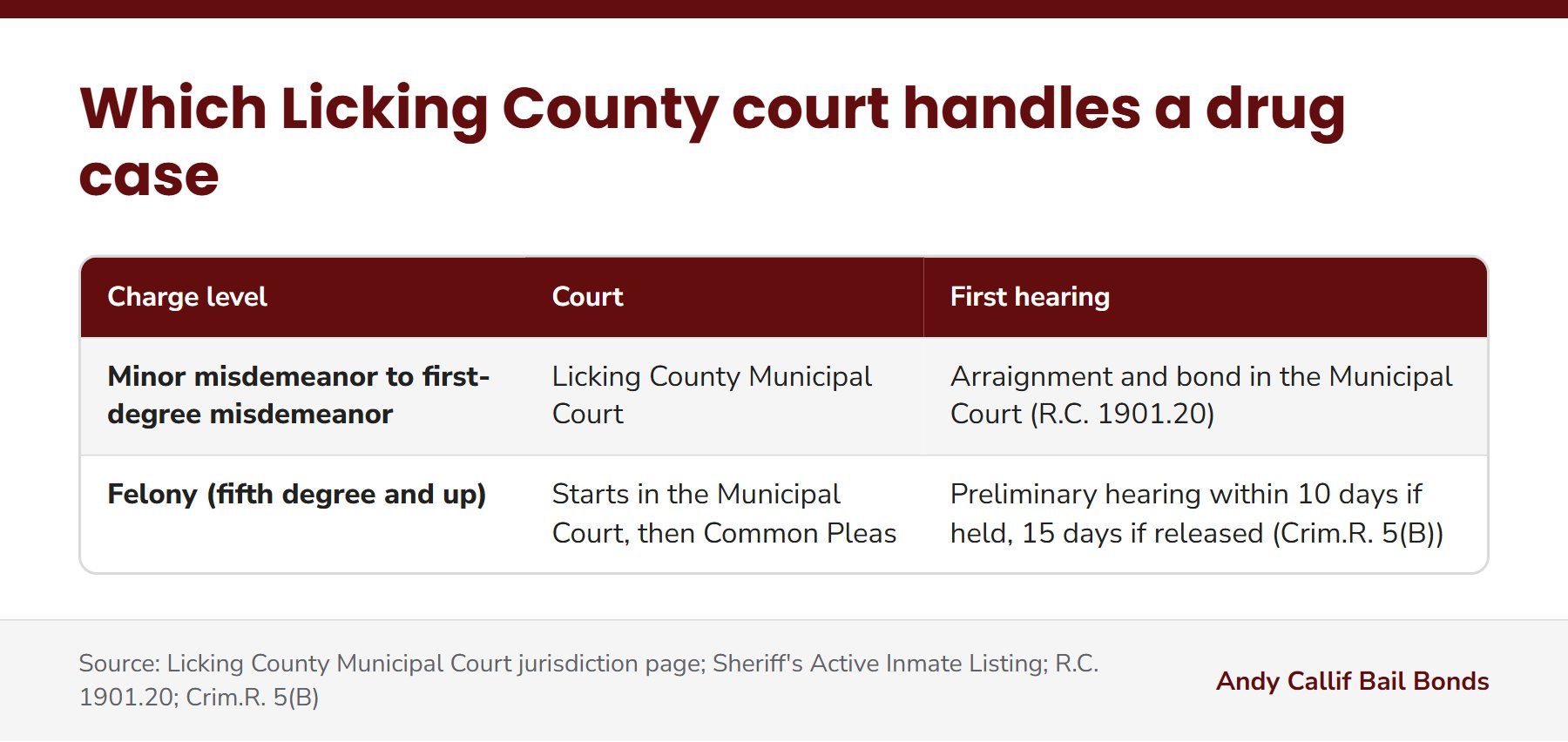
After a drug arrest anywhere in Licking County, the grade of the charge decides the court. Misdemeanor drug cases go to the Licking County Municipal Court on West Main Street in Newark and stay there. Felony possession and trafficking charges are tried in the Licking County Court of Common Pleas. Recent felony drug arrests on the Sheriff’s jail roster are marked as waiting for a Common Pleas bond hearing, arraignment or indictment. That split decides who sets the bond and how drug bail bonds in Newark, Ohio get posted.
Andy Callif Bail Bonds writes surety bonds on Licking County drug charges at any hour. There is no Andy Callif office in Licking County; these bonds are written by our Columbus office, the nearest of our offices to the Newark courts.
This page follows a drug charge through the county’s courts. For booking, the inmate list and visits, turn to Licking County Jail and Courts: How Bail Works. For other charges in the county, start with Newark, OH Bail Bonds in Licking County.
Where a drug case goes in Licking County
The grade of the drug charge decides which Licking County court handles the bond. Misdemeanors stay in the Municipal Court, whose own jurisdiction page says it hears all traffic and criminal misdemeanors in the county and “also handles preliminary matters in felony cases.”
No official Licking County source we found says which court a felony complaint is filed in (checked October 18, 2026). Ohio law lets a municipal court hold a preliminary hearing in a felony case before indictment, then discharge the defendant, release them on a recognizance or commit them to jail (R.C. 1901.20(B)). The Municipal Court’s local rules list preliminary hearings and bond hearings among its special proceedings (Rule 11.00). The Sheriff’s Active Inmate Listing, though, shows recent felony drug arrests under CR docket numbers, with “AWAIT CPC INDICTMENT,” “AWAIT CPC ARRN” or “AWAIT CPC 1ST BOND HEARING” in the status column; CPC appears to stand for the Court of Common Pleas, though the listing does not define it (data as of October 17, 2026). For a felony drug charge, check with the Common Pleas Clerk of Courts about where the bond sits before paying anything.
| Point in the case | Court | What it means for the bond |
|---|---|---|
| Misdemeanor drug charge, such as paraphernalia or Schedule III to V possession | Licking County Municipal Court, 40 W. Main St. | Bond is set there and stays with that court through sentencing |
| Felony drug arrest, before indictment | Listing notes point to Common Pleas; no court rule confirms it | Check with the Common Pleas clerk about where the bond is held; R.C. 1901.20(B) lets either court act before indictment |
| Case bound over or indicted | Licking County Court of Common Pleas, General Division, 1 Courthouse Square | The Common Pleas judge on the case decides any request to keep, lower or change the bond |
Drug arrests here can come from city police, the Sheriff’s Office or the Central Ohio Drug Enforcement Task Force, which the Licking County Sheriff’s Office leads, according to an Ohio Attorney General release of Sept. 22, 2021. For a state charge filed in Licking County, the court path above is the same whichever agency made the arrest.
How soon a felony drug case gets its first hearing
Ohio Criminal Rule 5(B) sets the clock for the preliminary hearing on a felony complaint: 10 consecutive days after the arrest while the person remains jailed, or 15 consecutive days once released. An indictment from the grand jury before that date cancels the hearing, and the case goes forward in Common Pleas (Ohio Rules of Criminal Procedure).
If a bond was set before the indictment, ask the defense lawyer whether the Common Pleas judge will keep it or set a new one. Newark, OH Felony Bail Bonds covers the felony timeline, while Newark, OH Misdemeanor Bail Bonds deals with other lower-level charges.
How Ohio grades a drug charge
Ohio’s drug statutes (Revised Code, or R.C., Chapter 2925) set the starting grade by the substance, the amount and the conduct charged. A misdemeanor grade keeps the case in the Municipal Court; a felony grade puts it before the Common Pleas judges. The table gives the lowest grade for the charges this page covers.
| Charge | Statute | Starting grade | Where the bond ends up |
|---|---|---|---|
| Marijuana under 100 grams, over the adult-use law’s limits | R.C. 2925.11 | Minor misdemeanor | Municipal Court |
| Using or possessing drug paraphernalia, other than for marijuana | R.C. 2925.14 | Fourth-degree misdemeanor | Municipal Court |
| Selling paraphernalia, or making or holding it to sell | R.C. 2925.14 | Second-degree misdemeanor; first-degree if sold to a juvenile | Municipal Court |
| Possessing a syringe used to take an illegal drug | R.C. 2925.12 | Second-degree misdemeanor; first-degree with a prior drug conviction | Municipal Court |
| Schedule III, IV or V drug below the bulk amount | R.C. 2925.11 | First-degree misdemeanor; fifth-degree felony after a drug abuse conviction | Municipal Court; Common Pleas if filed as a felony |
| Cocaine under 5 grams; heroin or a fentanyl-related compound under 10 unit doses or 1 gram; any other Schedule I or II drug under the bulk amount | R.C. 2925.11 | Fifth-degree felony | Court of Common Pleas |
| Getting a dangerous drug by deception, such as a forged prescription | R.C. 2925.22 | Fifth-degree felony; fourth-degree for a Schedule I or II drug | Court of Common Pleas |
| Selling or offering to sell marijuana, cocaine, heroin, a Schedule III to V drug or a fentanyl-related compound | R.C. 2925.03 | Fifth-degree felony | Court of Common Pleas |
| Aggravated trafficking of a Schedule I or II controlled substance | R.C. 2925.03 | Fourth-degree felony | Court of Common Pleas |
Grades come from R.C. 2925.03, R.C. 2925.11, R.C. 2925.12, R.C. 2925.14 and R.C. 2925.22, read on the state code site on October 18, 2026.
What pushes a drug charge to a higher grade
- Amount. Each drug has its own weight ladder in R.C. 2925.11. Five grams of cocaine, for example, turns a fifth-degree felony into a fourth-degree one, and larger amounts climb higher.
- Where a sale happened. At the base level, a trafficking count rises one degree when the sale was near a school or a juvenile, which the statute calls the “vicinity” of either. For aggravated trafficking and cocaine trafficking, the same step applies near a substance addiction services provider or a person in recovery (R.C. 2925.03(C)).
- An earlier drug conviction. With one prior drug abuse conviction, possessing a Schedule III to V drug becomes a felony, and the syringe charge becomes a first-degree misdemeanor.
- Marijuana limits. The adult-use law caps what a person may hold, combined, at 2.5 ounces of plant material plus 15 grams of extract (R.C. 3796.221, effective March 20, 2026). A first-offense gift of no more than 20 grams counts only as a minor misdemeanor under R.C. 2925.03.
The grade on the arrest paperwork can change once the case is indicted. Either side can then ask to modify the bond, and unless the parties agree, the court must hold that hearing as promptly as possible (R.C. 2937.011(G)). Drug charges are bailable like most Ohio offenses; What Crimes Are Bailable in Ohio? explains the narrow exceptions.
How the bond amount is decided in a Newark drug case
For a drug misdemeanor, bond can come from the Municipal Court’s bond schedule. For a felony drug charge, a judge or magistrate fixes it, because Ohio law lets a schedule cover misdemeanors only (R.C. 2937.23). In the Municipal Court, the officer’s paperwork comes first.
Municipal Court Rule 8.00(d) requires the arresting officer to leave the full report, a record check and a bond recommendation with the court when the complaint is filed for anyone held in jail. The court has not posted its bond schedule online (October 18, 2026), and Rule 8.00(e) says some charges on that schedule need an appearance before a judge. The Municipal Court clerk can tell a family which applies to a given drug count.
When a judge sets the amount, R.C. 2937.011, division (E), lists what the court weighs. In a drug case those factors include:
- Which drug was found, how much, and whether police allege it was packaged or held for sale
- Whether a gun or other weapon was found or within reach
- How strong the evidence is, such as a field test or a lab report
- Earlier convictions and any past failure to appear
- Probation, parole, community control or another bond in place on the day of the arrest
- Family, work and years lived in the area
If money is part of the bail, R.C. 2937.011(B) calls for the least costly option that still reasonably assures the court the person will come back. How Much Will My Bail Be? gives worked examples of these factors.
The state surcharge on posted bail
Ohio adds a state surcharge whenever bail is posted on an offense other than a non-moving traffic violation (R.C. 2937.22, division (B)). The clerk hands it back if the charges are dismissed or the person is found not guilty. If the case ends with a forfeiture, a conviction or a guilty plea, the clerk forwards that money to Ohio’s indigent defense support fund. The surcharge is separate from any bail bond premium.
Release conditions on a Licking County drug bond
Ohio’s bail statute names drug cases directly. Under R.C. 2937.011(D)(7), a court can send the person for an assessment, then make its treatment advice part of the release terms, when the charge is tied to drug or alcohol use and treatment looks necessary.
Pretrial check-ins in each court
Both Licking County courts supervise people awaiting trial. The Municipal Court’s Adult Probation Department, on the 3rd floor of 40 W. Main St., posts a Pre-Trial Bond Check-In Form. On the felony side, Licking County Adult Court Services, 2 N. First St., provides pre-trial supervision of offenders awaiting action in the Common Pleas Court.
A skipped check-in or a failed test is a broken bond condition, not a paperwork slip. R.C. 2937.011(D) also lets the court add electronic monitoring, house arrest, work release, rules on travel and residence, limits on whom the person sees, supervision by a named person or agency, and day reporting. What Are the Conditions of Bail? describes how each one works day to day.
Drug court, diversion and treatment options in Licking County
Licking County’s drug programs run through the criminal case, not the bond, and one familiar route is closed to drug charges. The Municipal Court’s diversion program does not take drug cases. Its diversion application packet lists “Persons charged under chapter 2925 and 3719 of the Ohio Revised Code, any drug related offense” among those who are not eligible.
| Option | Court | What the official source says | What it means for a drug case |
|---|---|---|---|
| Diversion | Licking County Municipal Court | Up to a year of probation supervision; the charges are dismissed on completion | Not available: drug offenses are excluded |
| LIFT drug court | Licking County Municipal Court | The court’s page describes LIFT as a drug court certified by the Supreme Court of Ohio’s Specialized Dockets Section | No eligibility rules are posted; ask the defense lawyer whether it is taking cases |
| Drug Court | Licking County Court of Common Pleas | Listed among the programs of Adult Court Services; the Supreme Court of Ohio’s certification status sheet (March 10, 2022) shows the Common Pleas drug docket as certified | Entry is decided in the felony case, not at the bond hearing |
| Intervention in lieu of conviction (ILC) | Either court | Requested before any guilty plea when drug or alcohol use was a factor; a court-supervised plan of at least one year and at most five, with no drugs or alcohol, treatment and random tests, ends in dismissal (R.C. 2951.041) | Closed to first-, second- and third-degree felonies, trafficking above the fifth degree and charges that carry mandatory prison |
An ILC request is filed before any guilty plea. It waives the right to a speedy trial and, if they have not happened yet, the preliminary hearing, the grand jury time limit and arraignment; when drug or alcohol use is alleged, the court may first order an assessment by a community addiction services provider or another qualified professional (R.C. 2951.041).
A defense lawyer decides whether to request any of these and when. While a request is pending, the person keeps every condition of the bond. Sources: the court’s Licking County Municipal Court page, Adult Court Services, the Supreme Court of Ohio status sheet and R.C. 2951.041.
When the arrest followed an overdose call
Ohio’s overdose immunity can keep a small possession charge from being filed at all. Under R.C. 2925.11(B)(2), a person who seeks medical help in good faith for an overdose, the person who overdosed, and the person help was sought for cannot be arrested, charged or convicted of a minor drug possession offense, meaning a misdemeanor or fifth-degree felony under that section, based on evidence found because of the call.
The person must get a screening and a treatment referral within 30 days, and nobody can use the immunity more than twice. It does not cover trafficking or other crimes.
Getting a drug bond posted in Licking County
A bond can be posted once the schedule or a judge has set one. These steps fit a drug arrest in either court:
- Find every case. Start with the Licking County Sheriff’s Active Inmate Listing; copy down the booking number, every docket number and any bond amount. A single drug arrest may lead to several counts, sometimes with a separate bond on each case.
- Match each docket to its clerk. A misdemeanor docket belongs to the Municipal Court clerk on the 3rd floor of 40 W. Main St., which closes from noon to 1 p.m. on weekdays. For a felony, start with the Common Pleas Clerk of Courts, 1 Courthouse Square, even before an indictment, and ask where the bond is held.
- Ask about holds. Even after the Licking County drug bond is posted, a probation hold or another county’s warrant can keep the person in jail.
- Choose how to post. Depending on the court’s order, the family can post full cash, a 10% deposit, or use a surety bond. With a surety bond, the family pays a premium to a licensed agent instead of the whole amount; that premium tracks the premium rate filed with the Ohio Department of Insurance, a rule set out in R.C. 3905.93. How Much Does a Bail Bond Cost in Ohio? breaks down what goes into it.
- Sign and keep the paperwork. Once the co-signer has signed the bond agreement, keep the bond receipt and the first court date together in one place.
- Book the assessment early. If the order requires a drug or alcohol assessment, or a check-in with probation or Adult Court Services, set it up in the first days after release and save proof of each visit.
After the bond is posted, the Licking County Justice Center completes the release on its own schedule, and a hold from another case can delay it.
Reach us by phone at any hour. Our office is open until 5 p.m.; for a drug bond set later in the day, we agree on a time and place, either the courthouse or our Delaware office, to meet the family, or we send the paperwork by email for signatures and take the payment by phone.
Details to gather before you call us
- The person’s legal name as it appears on the Sheriff’s listing, plus a birth date
- Every docket number and charge with its level, such as (F5) or (Misdemeanor)
- The bond amount and type on each case, for example CASH/SURETY
- Whether the person is on probation or community control, or has a case open elsewhere
- Treatment the person has already started, which the defense lawyer may raise with the judge
Whoever co-signs a Licking County drug bond will need a government ID and proof of a current job, and on some bonds we review a tax return or a 1099 before signing.
Staying in good standing on a Licking County drug bond
Every term in the release order counts until the case closes, in whichever court has it.
- Keep every hearing date, pretrials included, and check the Municipal Court’s records search or the Common Pleas case search before each one.
- Attend every assessment, treatment session and check-in, and keep proof of each.
- Stay away from the people and places the order names, and avoid any new arrest.
- Ask early for a new date if one is needed. In the Municipal Court, Rule 8.00(f) requires a written motion, and a request made less than seven days before trial is not considered unless the reason could not have been known sooner.
- Tell the court, the defense lawyer and us right away when the person moves or changes phone numbers.
Missing a date can bring a warrant and a forfeiture of the bond. Newark, OH Warrant Bail Bonds covers turning in on a Licking County warrant, and our guide What Happens If You Miss Court While Out on Bail? lists the steps to take the same day.
Call us with the docket numbers from the jail list
When a family member is booked into the Licking County Justice Center on a drug charge of any grade, our Columbus office answers (614) 221-0100 day or night. Read us the docket numbers from the Sheriff’s listing, and we will say which court holds each bond and quote our premium before you sign. Andy Callif Bail Bonds has earned 900+ Google reviews. Prefer to write? Reach us through Contact Us, and Our Bail Bond Process shows each step.
Andy Callif Bail Bonds (Callif Bonding LLC), 350 S. High St., Columbus, OH 43215
We post bonds; we do not give legal advice. A criminal defense attorney can advise on the drug charge itself.
Frequently asked questions
Which court sets bond on a drug charge in Newark, Ohio?
Drug misdemeanors get their bond in the Licking County Municipal Court. A felony drug case is heard in Common Pleas, and recent felony arrests on the Sheriff’s jail roster are marked as waiting for a Common Pleas first bond hearing. Confirm with the Common Pleas Clerk of Courts where a felony bond is held.
Can a drug charge go through diversion in the Licking County Municipal Court?
No. The court’s diversion application packet makes anyone charged under R.C. Chapters 2925 and 3719, or with any drug-related offense, ineligible. Intervention in lieu of conviction under R.C. 2951.041 is a separate option a defense lawyer can ask about.
Is there a drug court in Licking County?
Licking County Adult Court Services lists a drug court among its Common Pleas programs, and the Municipal Court describes its LIFT drug court as certified by the Supreme Court of Ohio. Neither court posts current eligibility rules online, so ask the defense lawyer.
Will my relative have to do drug treatment while out on bond?
Possibly. If drug or alcohol use was involved and treatment appears necessary, R.C. 2937.011(D)(7) lets the court order an assessment and make its treatment recommendations a release condition. The court can also order supervision, such as pretrial check-ins.
Are there fees on top of the bail amount in Ohio?
On most offenses, Ohio law tacks a state surcharge onto posted bail, and it is refunded if the charges are dismissed or the person is acquitted. A surety bond also carries the agent’s premium, which comes from the premium rate filed with the Ohio Department of Insurance.
What happens if someone calls 911 for an overdose and drugs are found?
Under R.C. 2925.11(B)(2), a person who seeks help in good faith, and the person who overdosed, cannot be charged with minor drug possession based on evidence found because of that call. Each must get a screening and treatment referral within 30 days, and the protection can be used only twice.
How do I post a drug bond in Newark, Ohio?
Confirm each case and its bond on the Sheriff’s inmate list first. The family can pay the court in cash, or as a 10% deposit when the court allows it, at the clerk’s office on a weekday. A surety bond instead makes a licensed agent answerable for the full amount, while the family pays that agent’s premium. The jail releases the person once every bond is posted and no hold remains.
How soon is the first hearing on a felony drug charge?
Ohio Criminal Rule 5(B) sets the preliminary hearing no more than 10 consecutive days after arrest for someone held in jail, or 15 for someone released. No preliminary hearing is held if the grand jury indicts first.