
By Andy Callif, licensed Ohio surety bail bond agent (license 594192; Callif Bonding LLC license 42586). Reviewed November 2026.
Someone arrested in Delaware, Ohio, or anywhere else in Delaware County is usually taken to the Delaware County Jail at 844 US Highway 42 North. A judge or the court’s bail schedule then sets the terms of release: the Delaware Municipal Court handles misdemeanors, and felony cases go to the Delaware County Court of Common Pleas from the first appearance.
Andy Callif Bail Bonds writes bail bonds in Delaware, Ohio, and across Delaware County from our office at 84 N. Sandusky St. downtown, and the business has been family-run since 1960.
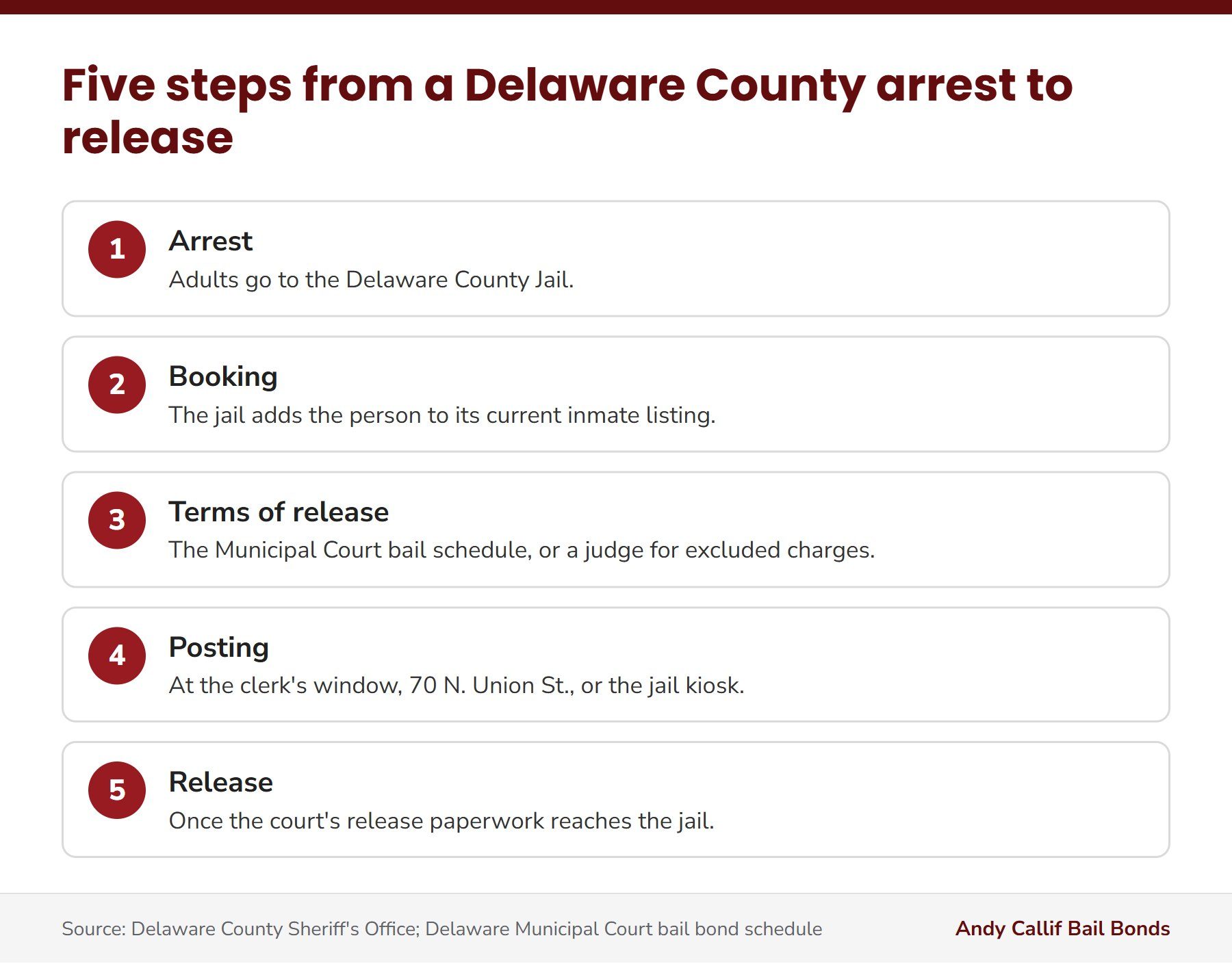
Five steps from a Delaware County arrest to release
Bail in Delaware County follows five steps, and families usually handle the fourth.
- Arrest. Delaware police, the Delaware County Sheriff’s Office, or another local agency makes the arrest, and adults go to the county jail.
- Booking. The jail records the charges and adds the person to its current inmate listing.
- Terms of release. The Delaware Municipal Court’s bail schedule covers many misdemeanors. Charges the schedule leaves out, such as domestic violence, a protection order violation, or a third lifetime OVI, wait for a judge to set bond.
- Posting. Money goes to the court that has the case. Municipal Court bonds can be paid at the clerk’s window, 70 N. Union St., which closes at 4 p.m. on weekdays, or at any hour at the jail kiosk the court has announced; felony matters in Common Pleas run through the Clerk of Courts at 117 N. Union St.
- Release. The jail lets the person go once the court’s release paperwork arrives.
Our page Delaware County Jail and Courts: How Bail Works goes deeper on booking, the inmate list, visits, and how each court sets and accepts bond, including at night and on weekends.
My advice on timing: In most counties, bonds can be posted Monday through Friday, and only until 4 p.m., especially for felony cases; smaller counties also have shorter bond-posting hours than Franklin County. For a Delaware County arrest, call our office first, and we will walk you through it.
The jail and courts that handle Delaware County cases
One county jail and, depending on the charge, one of three courts or clerk’s offices handle almost every Delaware County criminal case. The Municipal Court’s reach covers the whole county under R.C. 1901.02.
| Office | What it handles | Address |
|---|---|---|
| Delaware County Jail (Sheriff’s Office) | Holds adults arrested in the county and posts a current inmate listing | 844 US Hwy 42 N, Delaware, OH 43015 |
| Delaware Municipal Court | Misdemeanor, traffic, and OVI cases from all of Delaware County; the clerk’s office is open weekdays from 8 a.m. to 4 p.m. | Justice Center, 70 N. Union St., Delaware, OH 43015 |
| Delaware County Court of Common Pleas, General Division | Original jurisdiction over every adult felony case in the county | Delaware County Courthouse, 117 N. Union St., Level 500, Delaware, OH 43015 |
| Delaware County Clerk of Courts, Legal Division | Records and filings for Common Pleas felony cases; open 8 a.m.-4:30 p.m. on weekdays | 117 N. Union St., Level 300, Delaware, OH 43015 |
Bond is paid to the court with the case; for Municipal Court bonds only, the court has also announced a 24/7 kiosk inside the jail. Bail bond agents who write bonds in Common Pleas must register with that court, with registration due by April 1 in every odd-numbered year, and the Clerk of Courts keeps the registration list. You can check the Sheriff’s inmate information page for the jail’s own instructions.
Types of Release in Delaware County
Ohio courts can release a defendant on citation, recognizance, an unsecured or 10% deposit bond, full cash, real estate, or a surety bond (R.C. 2937.011). Delaware County courts use each of these, and the charge and the defendant’s residence often determine which one applies.
| Release type | Where it shows up in Delaware County | What gets put up |
|---|---|---|
| Citation | Most minor misdemeanors, under R.C. 2935.26 | No money; a signed ticket with a court date |
| Own recognizance | County residents on most misdemeanors under the Municipal Court schedule, or any case where a judge is satisfied the person will appear | The defendant’s signed promise to appear |
| Unsecured bond | Set by a judge; Common Pleas pairs it with recognizance on one form | Nothing at release; the bond amount is owed only after a breach |
| 10% deposit | Allowed by the Municipal Court schedule and R.C. 2937.011 | One-tenth of the bond in cash, held by the clerk |
| Full cash | Any bond, if the defendant chooses to pay it all | The entire bond amount in cash, held by the clerk |
| Real estate | Bonds secured by property located in Delaware County | A pledge of the property instead of cash |
| Surety bond | Most bonds set as a dollar amount | The agent’s filed premium; the insurer behind the agent backs the whole bond |
How that plays out in Delaware County, using the Municipal Court schedule and the Common Pleas form:
- A Delaware County resident arrested on a fourth-degree misdemeanor signs a personal recognizance bond and leaves without posting money.
- A resident of another Ohio county facing the same charge posts the schedule bond by 10% deposit, full cash, Delaware County real estate, or a surety bond.
- A person arrested for domestic violence stays in jail until a judge sets the release terms, which can be recognizance or a money bond.
- A driver cited for a minor misdemeanor gets a ticket with a court date instead of going to jail.
- A defendant indicted on a felony may sign the Common Pleas recognizance or unsecured bond form, or the judge may set a money bond that a surety can cover.
Our guide What Are the Types of Bail in Ohio? compares the same options statewide.
Citation Release Instead of an Arrest
A citation release means the officer writes a ticket with a court date and lets the person go instead of booking them. Under R.C. 2935.26, an Ohio officer must cite rather than arrest for a minor misdemeanor unless one of these is true:
- The person needs medical care or cannot keep themselves safe.
- The person cannot or will not prove their identity.
- The person refuses to sign the citation.
- The person was cited before for the same offense and did not appear or comply.
The Delaware Municipal Court’s schedule says the same thing in its own words: minor misdemeanors and unclassified misdemeanors with no possible jail time call for a citation rather than a bond. Missing the date on a citation can lead the court to issue a warrant, and then the case needs bail like any other arrest.
Released on Your Own Recognizance in Delaware County
Release on your own recognizance means the court lets the person leave on a signed promise to return, with no money posted (R.C. 2937.29). Failing to appear after that promise is a separate offense under R.C. 2937.99: a first-degree misdemeanor when the original charge was a misdemeanor, and a fourth-degree felony when it was a felony. R.C. 2937.011(K) adds that any bail given for the release may be forfeited, and that a broken condition lets the court amend the bail.
Under the Delaware Municipal Court bail bond schedule that took effect May 20, 2024, Delaware County residents charged with a misdemeanor of any degree are released on their own recognizance after signing a personal recognizance bond. People who live outside the county post bond under the schedule instead, and the charges the schedule excludes still go to a judge.
In felony cases, the Court of Common Pleas uses a Personal Recognizance Bond or Unsecured Bail Bond form. A defendant who signs it agrees to:
- Attend every hearing in the case
- Stay out of legal trouble while the case is open
- Follow each bail condition the judge or magistrate sets
- Give their attorney a current phone number and address, and answer the attorney’s calls and letters
- Stay in Ohio unless the court allows travel
- Sign a waiver of extradition under R.C. 2963.24
For who qualifies and how judges decide, read What Does It Mean to Be Released on Your Own Recognizance?
Cash Bail and the 10% Deposit Bond
Cash bail means paying the full bond to the clerk, who holds it until the case ends. With a 10% deposit bond, the defendant pays one-tenth of the bond in cash; Ohio law returns 90 percent of that deposit once the bond conditions are met, and a breach leaves the depositor owing the balance. On a $1,000 bond, that is a $100 deposit with $90 refunded.
Cash bail carries the same duty as any other bond: the person must appear at every hearing, and if they do not, R.C. 2937.35 allows the court to declare a forfeiture in open court. Once forfeiture is declared, R.C. 2937.36(A) requires the clerk to treat the deposited cash as a fine, apply it to costs, and pay it out as the law directs, so a missed date can cost the whole deposit.
Cash posted with the court does not always come back in full. The court’s 2025 annual report lists $812,309.51 in bonds released and $10,100 paid to the city as court costs.
Property Bonds Secured by Real Estate
A property bond pledges land or a house instead of cash. The Municipal Court schedule accepts a bond secured by real estate in Delaware County, and R.C. 2937.011 lists real estate among the securities Ohio courts can take. The court decides whether the property’s title and value are sufficient, so ask the clerk what proof it needs before the hearing. If the defendant skips court, the pledged property is at risk.
Our guide How Does a Property Bond Work? walks through the paperwork.
Surety Bonds Backed by an Insurance Company
Most families need a surety bond when they look for a bail bondsman in Delaware. A licensed agent files a bond for the full amount with the clerk, backed by an insurance company, and the family pays the agent a premium instead of the full bail amount. If a judge orders a cash-only bond, ask the clerk whether a surety bond can satisfy that order.
Here is what the agent does on a Delaware County bond:
- Confirms the case, court, and bond amount with the clerk or jail before anyone signs.
- Posts a bond covering the full bail at the court with the case, so your cost is the premium rather than the bail itself.
- Stays on the case until it ends: we give you each court date when you call, and we help you work through the court process.
What You Pay for a Surety Bond in Delaware County
The cost of a Delaware County bail bond is the agent’s premium: the rate that the agent filed with the Ohio Department of Insurance, applied to the bond amount the judge or the schedule set (R.C. 3905.93). No agent may lower that premium with a rebate or a gift to the defendant (R.C. 3905.932). Be wary of any quote below the filed rate.
- The premium is the agent’s charge for writing the bond, and we do not refund it when the case ends.
- Collateral is rare with us, and when a bond calls for it, we accept only cash covering the full bond amount. We give a written receipt, hold the cash in trust until the case ends, and then return it less the premium (R.C. 3905.92).
- Nobody pays the jail. The Sheriff’s Office warns that callers demanding money for an electronic monitoring device before a release are running a scam.
A co-signer signs the indemnity agreement and can owe the bond amount if the defendant runs. Read What Does It Mean to Co-Sign a Bail Bond? before signing, and see How Much Does a Bail Bond Cost in Ohio? for premiums and collateral in more detail.
Signing for a Delaware County bond with us requires a government-issued ID and proof of employment, and for some bonds, a 1099 or tax return too.
Six Charges and the Court that Hears Each
Each of our six Delaware charge pages names the court that hears that charge in Delaware County and how bond is set for it.
- Delaware, OH DUI Bail Bonds: OVI is Ohio’s name for impaired driving, the Delaware Municipal Court runs its own OVI docket, and a third lifetime OVI needs a judge to set bond.
- Delaware, OH Domestic Violence Bail Bonds: domestic violence and assault are left off the Municipal Court schedule, so a judge sets the bond and any no-contact terms.
- Delaware, OH Drug Crime Bail Bonds: possession and trafficking charges can stay in Municipal Court as misdemeanors or go to Common Pleas as felonies.
- Delaware, OH Felony Bail Bonds: felony bonds are set in the Court of Common Pleas, which hears every adult felony in the county.
- Delaware, OH Misdemeanor Bail Bonds: misdemeanor and traffic cases from every city, village, and township in the county go to the Delaware Municipal Court.
- Delaware, OH Warrant Bail Bonds: how to handle an open Delaware County warrant, including a bench warrant after a missed court date.
Gun Charges in Delaware County
An Ohio gun charge can be a first-degree misdemeanor or a felony as serious as the third degree, so the court and the bond depend on the exact charge.
- Carrying a concealed weapon is a first-degree misdemeanor. It can become a fourth-degree felony, for example, when the gun was loaded or had ammunition ready at hand, or when the person was previously convicted of the same offense or of an offense of violence (R.C. 2923.12).
- Having weapons while under disability, the charge for people the law bars from having guns, is a third-degree felony (R.C. 2923.13).
A misdemeanor gun case stays in the Delaware Municipal Court. A felony gun case goes to the Court of Common Pleas, where the judge sets the bond and its conditions.
Our Delaware Office and the Delaware County Communities We Serve
Our Delaware office is at 84 N. Sandusky St., Delaware, OH 43015. It is not staffed every day, so call first, and we will set a time to meet you there or at the courthouse. From there, we serve all of Delaware County, the same area the Delaware Municipal Court covers:
- Cities: Delaware, Powell and Sunbury
- Villages: Ashley, Galena, Ostrander and Shawnee Hills
- Townships, including Berlin, Concord, Genoa, Liberty and Orange
Those names are a guide, not a limit, because between our Delaware and Columbus offices we cover all of greater Delaware and greater Columbus, Ohio.
Bonds from our Delaware office are written through Callif Bonding LLC (Ohio license 42586), the agency of Andy Callif, who holds Ohio surety bail bond agent license 594192. We lay out each step of a bond with us in our Bail Bond Process.
After Release: Keeping a Delaware County Bond in Place
A bond stays in force only as long as the defendant follows its terms. Delaware County courts offer a few tools that help families keep track:
- Text reminders: The Court of Common Pleas sends text reminders to defendants in criminal cases.
- Monitoring orders: the Municipal Court’s conditions of bond can include SCRAM alcohol monitoring, remote breath testing, GPS, or a SmartStart device, each set up and paid through the vendor the court names.
- Case lookups: the Clerk of Courts’ Records Search shows felony case activity in Common Pleas.
- Court dates from us: we do not send reminders. Call us within two or three days of the posting, and we can tell you the first court date; then check back with us for each later date, since one case can bring several hearings and notices from the court by mail often arrive late.
- A date you cannot make: phone the defense lawyer and the clerk ahead of time, not afterward.
If a date has already been missed, our guide What Happens If You Miss Court While Out on Bail? lists what to do first.
Reach Us About a Delaware County Arrest at Any Hour
If someone you love is in the Delaware County Jail, call (614) 221-0100 to reach Andy Callif Bail Bonds at any hour, or write to us through our Contact Us page. Let us know the court handling the case and, if you have it, the bond amount, and we will go over the premium and any collateral before anyone signs.
Andy Callif Bail Bonds (Callif Bonding LLC), 350 S. High St., Columbus, OH 43215
Nothing on this page is legal advice. An Ohio criminal defense lawyer can answer questions about the charges.
Frequently Asked Questions
Who sets bail in Delaware County, Ohio?
The Delaware Municipal Court sets misdemeanor terms, often through its bail bond schedule. The Delaware County Court of Common Pleas sets felony bond, where a magistrate holds the first appearance, and the judge controls bond from then on.
Can you get out of the Delaware County Jail without paying bail?
Often, yes. Most minor misdemeanors end in a citation, and the Delaware Municipal Court schedule releases county residents on their own recognizance for other misdemeanors. Charges the schedule excludes, such as domestic violence, wait for a judge, who decides the release terms.
What does released on recognizance mean in Ohio?
It means the court lets the person go on a signed promise to return to court, without posting any money, under R.C. 2937.29. Failing to appear after a recognizance release is its own offense, so every court date still counts.
What is a citation release?
An officer issues a citation with a court date instead of arresting you. Ohio requires it for most minor misdemeanors unless the person needs medical care, cannot prove who they are, refuses to sign, or ignores an earlier citation for the same offense.
Can you use a house for bail in Delaware County?
Yes. The Delaware Municipal Court bail schedule allows a bond secured by real estate in the county. The court must accept the property’s title and value, and the property is at risk if the defendant misses court.
What does a bail bond cost in Delaware, Ohio?
The agent’s premium is set by the rate the agent has on file with the Ohio Department of Insurance, calculated from the court-set bond amount. Agents may not offer rebates that lower it.
Where is your Delaware office?
Our Delaware office is at 84 N. Sandusky St., Delaware, OH 43015, and we meet clients there by appointment; call first, and we set a time at the office or at the courthouse. It serves Delaware, Powell, Sunbury, and the rest of Delaware County.
How do I check a bail bondsman in Delaware County?
Search the agent’s name in the Ohio Department of Insurance’s online agent lookup, and ask whether the agent is registered with the Delaware County Court of Common Pleas. Ask for the filed premium and a written collateral receipt. A quote below the filed rate, or an agent who approaches you at the jail or courthouse, is a warning sign.