

The moment a loved one is arrested, the legal system transforms from an abstract concept into a pressing, high-stakes reality. Families are often thrust into a world of terminology like “bond schedules,” “surety,” and “court appearances” without warning.
In Ohio, the criminal justice process often hinges on the initial bond hearing, a critical juncture where a judge determines whether a defendant remains in jail or returns home while awaiting trial.
While the presumption of innocence is the bedrock of our legal system, the reality of jail time is immediate. Understanding how average bail amounts are determined and why they fluctuate is essential for anyone attempting to navigate this overwhelming process effectively.
Understanding Bail in Ohio: More Than Just a Dollar Amount
The Primary Purpose: Ensuring an In-Court Appearance
At its core, the primary purpose of bail in Ohio is to ensure that a defendant returns to court for all scheduled proceedings. It is not intended to be a form of preventative detention or a way for the state to generate revenue.
When a judge sets a bond, they are essentially creating a financial incentive or a set of conditions that compel the individual to comply with the court’s schedule. If the defendant fails to appear, the court forfeits the bond, and a warrant is typically issued for their immediate arrest.
Bail vs. Fine: Why Pretrial Release is Not a Punishment
It is a common misconception that bail is a punishment. A fine is a penalty imposed after a conviction; bail is a pretrial mechanism. Because a defendant is legally presumed innocent until proven guilty, the court must balance the need to protect the public with the individual’s right to liberty.
Judges are tasked with determining the minimum amount necessary to ensure the defendant shows up for their court appearance, rather than imposing an exorbitant fee that serves as a de facto sentence without a trial.
Call (614) 221-0100 today to speak with our experienced Ohio bail bondsman!
The Legal Framework: How Ohio Rules of Criminal Procedure, Rule 46, Shapes Your Bond
The Shift from Fixed Bond Schedules to Individualized Assessment
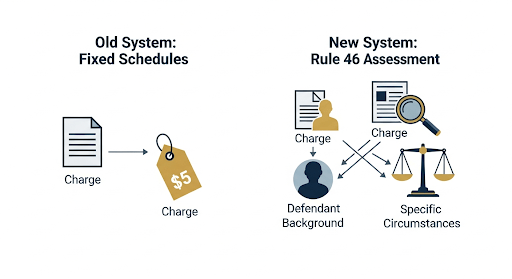
Historically, many jurisdictions relied heavily on “bond schedules”, rigid, pre-set lists of dollar amounts tied directly to specific charges. However, Ohio Rules of Criminal Procedure, Rule 46, has shifted the focus toward individualized assessments.
Today, a judge must evaluate the specific circumstances of the offense and the unique background of the defendant. This prevents a “one-size-fits-all” approach, allowing for more equitable outcomes that reflect the realities of the defendant’s life rather than just the label of the charge.
The Impact of House Bill 1 and Recent Bail Reform Efforts
Recent legislative efforts in Ohio, including components of House Bill 1, have sought to modernize pretrial detention. These reforms aim to reduce the reliance on cash-based systems that may keep low-risk defendants incarcerated simply due to an inability to pay.
The shift is moving away from purely financial calculations and toward evidence-based risk assessment tools, ensuring that jail beds are reserved primarily for those who pose a legitimate danger to the community or a high risk of flight.
The Role of the Ohio Supreme Court in Modernizing Pretrial Detention
The Ohio Supreme Court has been instrumental in providing guidance to lower courts regarding the use of bail. By emphasizing that pretrial detention should be the exception rather than the rule, the high court has pressured local municipalities to justify high bond amounts.
This has led to a more nuanced application of the law, where judges are increasingly encouraged to consider non-financial conditions of release before resorting to significant cash bonds.
How Judges Determine Felony Bail: The Risk Assessment Process
Utilizing Pretrial Risk Assessment Tools
Modern Ohio courts increasingly utilize structured risk assessment tools to categorize a defendant’s likelihood of failing to appear or committing new crimes. These tools evaluate factors such as employment status, ties to the community, and housing stability.
By relying on data-driven inputs, judges can make more informed decisions about whether a defendant can be safely released under specific conditions or if they require a traditional bond.
Evaluating Public Safety and the Risk of Non-Appearance
When setting a bond amount, the judge must balance two competing interests: the risk of flight and the risk of danger to the community. In cases involving violent offenses, the public safety component takes precedence.
The judge will analyze whether the defendant has a history of fleeing from authorities or if they represent an immediate threat to the victim or the public at large.
The Weight of Prior Criminal Records and Recidivism History
A defendant’s past interactions with the law carry substantial weight. If an offender has a lengthy criminal record, especially involving similar charges, the judge is statistically more likely to set a higher bond amount.
Conversely, a defendant with a clean record or minimal history is far more likely to be granted an Own Recognizance (OR) bond or a significantly lower financial requirement.
Contact our bail bondsman today at (614) 221-0100 to get your bail bond now!
Estimating Bail by Felony Degree: What the Numbers Look Like
First-Degree Felonies (F-1): Aggravated Murder, Rape, and Major Drug Offenders
For F-1 felonies, which include the most serious crimes like Aggravated Murder and high-level Rape charges, bonds are routinely set in the range of $100,000 to $1,000,000 or more. Because the potential penalties are life-altering, the risk of flight is considered extremely high.
In cases of Aggravated Murder, judges frequently deny bail entirely if there is “proof evident or presumption great” that the defendant committed the act.
Second-Degree Felonies (F-2): Felonious Assault and Manufacturing of Drugs
For F-2 offenses, such as Felonious Assault, typical bond amounts generally range from $25,000 to $100,000. The judge will consider the severity of the injuries and the strength of the prosecution’s evidence.
Manufacturing drugs often carries significant weight, as the court views these as persistent threats to community safety.
Third-Degree Felonies (F-3): Voluntary Manslaughter and Serious Stalking Charges
Third-degree felonies often see bonds in the range of $10,000 to $50,000. Charges like voluntary manslaughter involve complex emotional and situational factors that the court must dissect.
Judges frequently mandate additional conditions in these cases, such as strict no-contact orders with victims or witnesses.
Fourth and Fifth-Degree Felonies (F-4 & F-5): Felony OVI, Fleeing and Eluding, and Grand Theft
F-4 and F-5 charges are the most common felonies seen in municipal courts. Bonds here are often more modest, ranging from $2,500 to $10,000.
In instances of a Felony OVI or Fleeing and Eluding, the bond amount is often tied to the defendant’s history of traffic violations and the specific threat posed to public safety during the commission of the offense.
Our bail bondsman is available 24/7. Call us at (614) 221-0100
Common Felony Charges and Their Typical Bond Implications
Violent Crimes: Murder, Rape, and Aggravated Assault
Violent crimes occupy the highest tier of bond scrutiny. Courts are hesitant to release defendants accused of Murder or Rape without significant financial assurance or strict monitoring because the motivation to flee is high and the threat to the public is significant.
Drug-Related Offenses: Aggravated Trafficking vs. Possession
Trafficking charges generally command higher bond amounts than simple possession. The court views trafficking as an ongoing operation, whereas possession is often viewed as a personal struggle, leading to disparate financial requirements.
Domestic Violence and Violations of Temporary Protection Orders (TPO)
Domestic Violence cases are unique because the judge must specifically assess the danger to the household. Violating a TPO is often viewed by the court as a direct defiance of judicial authority, which almost invariably leads to a higher bond amount being set to ensure future compliance.
High-Level Traffic Offenses: Vehicular Homicide and DUI – First Offense Felony Upgrades
When a traffic-related offense is elevated to a felony, such as Vehicular Homicide, the court treats the incident with the same gravity as other violent crimes. Felony OVI charges often require the defendant to participate in mandatory monitoring programs as a condition of their bond.
Types of Bonds Issued in Ohio Felony Cases
Own Recognizance (OR) Bonds: Release Without Payment
An OR bond is the best-case scenario for a defendant. It signifies that the court trusts the individual to return to their court appearance without requiring any financial collateral. This is typically reserved for low-risk, first-time offenders with deep local community roots.
Surety Bonds: Working with a Surety Bail Bond Agent
A surety bail bond agent steps in when a family cannot afford the full cash bond. The agent charges a non-refundable fee, typically 10%, to guarantee the full amount to the court. While this allows the defendant to get out of jail, the family must understand they will not recover the premium paid to the agent.
Cash Bonds: Paying the Full Offense Amount to the Clerk of Courts
In some cases, a judge may mandate a cash bond. This requires the defendant or their family to deposit the full amount of the bail directly with the Clerk of Courts. This money is held until the case is resolved, provided the defendant attends every required court appearance.
Property Bonds: Using Real Estate and Deeds as Collateral
If the bond amount is exceptionally high, families may offer real estate as collateral. This involves placing a lien on the property. If the defendant skips their court appearance, the court can initiate the process of seizing the property to satisfy the bond amount.
Alternatives to Cash Bail: Conditions of Pretrial Release
Electronic Monitoring: TAD (Transdermal Alcohol Detector) and GPS Tracking
Courts often use electronic monitoring to provide a “middle ground” between jail and total freedom. GPS tracking is standard for high-risk defendants, ensuring the court knows their location at all times.
SCRAM Systems for Felony OVI and Alcohol-Related Offenses
For cases involving alcohol, such as a Felony OVI, the court may require a SCRAM (Secure Continuous Remote Alcohol Monitor) device. This system tests the defendant’s perspiration for alcohol consumption, acting as an additional check to ensure compliance with sobriety requirements while they await trial.
Call Andy Callif Bail Bonds For Help
Navigating the Ohio bail process is an exercise in both legal strategy and crisis management. Understanding that bail is not a punishment, but a procedural tool, is the first step toward effective advocacy.
Whether dealing with a Felony OVI or more severe violent charges, the role of a seasoned defense attorney cannot be overstated; they are your most vital asset in arguing for a reduction in bond or an Own Recognizance release.
By preparing for the bond hearing with clear evidence of community ties, stable employment, and a support system, you provide the judge with the necessary justification to set a reasonable bond.
Always remember that the initial bond hearing is not the end of the road but a critical opportunity to secure the defendant’s liberty during the pendency of the case. Reach out to a qualified attorney immediately upon arrest to ensure your rights are protected throughout this complex legal journey.
Our Ohio bail bondsman is available 24/7, call us (614) 221-0100!