

What Is a Flight Risk in Court?
When someone asks, “What is a flight risk?” they are usually asking one of two things.
They may mean:
- What does flight risk mean in court?
- Will the judge think I am going to run?
In criminal court in the United States, a flight risk is someone the judge believes may not return for future court dates if released before trial.
That label matters because it can affect whether a person is released, how high bail is set, whether a Columbus bail bondsman can help, and what conditions the court may require.
Bail is not supposed to punish someone before they are convicted. Bail exists to help make sure the defendant appears in court.
That is the heart of the issue.
The court is asking one question:
Can we trust this person to come back?
The answer can decide whether the person goes home or stays in jail.
Call (614) 221-0100 today to speak with our experienced Ohio bail bondsman!
Flight Risk Meaning
The plain-English flight risk meaning is simple: a person may leave, hide, miss court, or fail to follow release terms while a criminal case is pending.
In court, the meaning is more exact.
A judge may view someone as a flight risk if facts suggest the person may not return for:
- Arraignment
- Bond hearings
- Pretrial hearings
- Trial
- Sentencing
- Probation hearings
- Other required court appearances
A judge does not need a crystal ball. The judge looks at the facts available at the hearing and decides whether release can be managed safely.
That does not mean every person with a past mistake is automatically treated as a flight risk. It means the judge may weigh that history when deciding what conditions are needed.
Ohio Revised Code (ORC) 2937.22 establishes the legal framework for how bail operates as security to ensure an accused person appears for their trial.
What Is a Flight Risk in Court?
A flight risk in court is a defendant the judge believes may not come back unless the court sets stronger conditions.
Those conditions may include:
- Cash bail
- A surety bond through a bail bondsman
- Regular check-ins
- Travel restrictions
- Electronic monitoring
- A requirement to stay in the county or state
- Surrender of a passport
- No-contact orders
- Drug or alcohol monitoring
- Pretrial supervision
In many cases, a person can still be released even if the court sees some risk. The judge may set conditions designed to lower that risk.
The court is not looking for a perfect guarantee. It is looking for enough structure to trust that the defendant will appear.
Contact our bail bondsman today at (614) 221-0100 to get your bail bond now!
Why Flight Risk Affects Bail
Bail and flight risk are tied together.
When the court sees low risk, release may be easier. A defendant may receive:
- Own recognizance release
- A lower cash bond
- A surety bond
- Nonfinancial release conditions
- Basic pretrial supervision
When the court sees higher risk, bail may rise.
A judge may set a higher amount because the court believes the defendant needs a stronger reason to return. A judge may also add conditions because money alone may not solve the issue.
That is why two people charged with similar crimes may receive very different bail amounts.
One person may have:
- A steady job
- Local family
- No missed court dates
- A long history in the same community
- Reliable transportation
- A stable address
Another person may have:
- Prior failures to appear
- No local address
- No job
- Active warrants elsewhere
- A history of ignoring court orders
- Out-of-state connections
The charge may look similar on paper. The risk picture may look completely different.
Our bail bondsman is available 24/7. Call us at (614) 221-0100
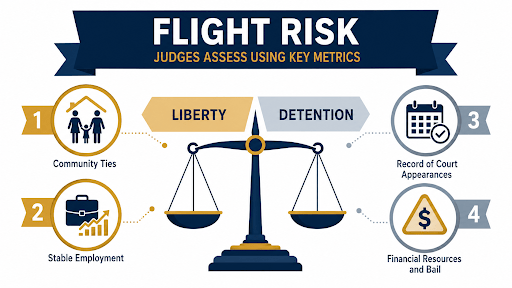
The Main Factors Judges Use to Decide Flight Risk
Judges usually look at a mix of personal history, case facts, and court history. No single factor decides everything. The judge looks at the full picture.
1. Community Ties
Community ties can reduce flight risk.
A person with family nearby, a steady home, children in school, local responsibilities, and long-term roots may be seen as less likely to leave.
Community ties can include:
- Family in the area
- A local home or lease
- Children in local schools
- Caregiving duties
- Church involvement
- Volunteer work
- Local medical care
- A long history of living in the same county
- Strong relationships with people who can help the defendant stay on track
These ties show the court that the person has something to lose by leaving.
For a bail bondsman, community ties can matter too. A bondsman wants to know the defendant can be located and will appear in court. Find out if bail amounts can be reduced.
2. Stable Employment
Stable employment can help lower the court’s concern.
A job gives a person routine. It creates a reason to stay. It may also show responsibility.
A defendant may be able to bring proof of employment to court, such as:
- Recent pay stubs
- A letter from an employer
- A work schedule
- A business license
- Tax records for self-employment
- Union documentation
- Proof of upcoming shifts
- Proof of military service or school enrollment
Proof of steady work does not erase the charge, but it can support the argument that the person is not likely to disappear.
3. Record of Court Appearances
Past court behavior is one of the strongest signals.
A person who has always appeared in court can point to that history. A person who has missed court before may have a harder road.
A past failure to appear does not always mean someone tried to run. Some people miss court because of:
- Transportation problems
- Childcare issues
- Medical issues
- Confusion about dates
- Lack of notice
- Work conflicts
- Fear
- Housing instability
Still, the court may view missed dates as a warning sign.
That is why every court date matters. Once a defendant misses a hearing, the next judge may be much less forgiving.
4. Criminal History
A prior criminal record may affect how the court views risk.
A judge may ask:
- Has this person been convicted before?
- Were the prior charges similar?
- Did the person comply with probation?
- Did the person miss court in past cases?
- Are there pending cases elsewhere?
- Is there a warrant?
- Has the person violated bond conditions before?
- Has the person left the area during a prior case?
A clean record can help. A long record can raise concern. A record with repeated failures to appear can raise even more concern.
5. Seriousness of the Charge
More serious charges can create more flight-risk concern. The court may think a person facing a long prison sentence has more reason to run than a person facing a lower-level offense.
For example, a person charged with a serious felony may face higher bail than a person charged with a misdemeanor.
That does not mean the person is guilty. It means the possible penalty can influence the court’s risk analysis.
The judge may consider:
- The felony level
- The possible prison sentence
- Whether the charge involves violence
- Whether there is an alleged victim
- Whether weapons were involved
- Whether drugs, large sums of money, or organized activity are alleged
- Whether the person has pending charges in another court
6. Financial Resources and Bail
Money can cut both ways. A person with no funds may struggle to post bail, but that alone does not mean they are a flight risk.
A person with large financial resources may be seen as able to leave the state or country if the case is serious.
A court may also consider whether the bail amount is realistic. If bail is so high that the person cannot post it, it can function like detention.
This is one of the most debated parts of pretrial justice. The court must protect the case without turning poverty into a jail sentence.
What Is the Difference Between Flight Risk and Danger to the Community?
Flight risk and danger are not the same thing. A person can be seen as a flight risk without being viewed as dangerous. A person can be viewed as dangerous without being likely to flee. Flight risk is about whether the person will appear in court.
Danger is about whether the person may harm another person, the alleged victim, a witness, or the public. Courts often consider both.
A judge may ask:
- Will this person come back?
- Will this person obey court orders?
- Will this person contact the alleged victim?
- Will this person commit another offense while released?
- Will this person interfere with witnesses?
- Will this person follow travel restrictions?
- Will this person check in with pretrial services?
- Will this person stay reachable?
That means a defendant may receive conditions beyond money bail.
How a Bail Bondsman Helps When Flight Risk Is Raised
A bail bondsman can help a family move quickly when a judge sets a surety bond.
A surety bond allows the bail bondsman to post a bond with the court so the defendant can be released. The family pays a non-refundable premium for the service. The bondsman then takes on financial risk tied to the defendant’s appearance.
A bail bondsman may also help explain:
- How the bond process works
- What information the family needs
- Why the defendant must attend every court date
- What happens if the defendant misses court
- What collateral may be required
- How to avoid bond forfeiture
- How to stay in contact after release
- What responsibilities the co-signer may have
A bail bondsman is not the defendant’s criminal defense lawyer. The bondsman does not defend the charge. The bondsman helps with the bail bond process.
That difference matters. The lawyer fights the case. The bail bondsman helps secure release. The defendant must do the rest by showing up, obeying release terms, and staying in contact.
What Happens If the Court Thinks You Are a Flight Risk?
If the court thinks a defendant is a flight risk, several things can happen.
The judge may:
- Set a higher bail amount
- Require a surety bond
- Require cash bail
- Require pretrial supervision
- Order travel limits
- Order electronic monitoring
- Require the defendant to surrender a passport
- Require drug or alcohol testing
- Require regular check-ins
- Prohibit contact with certain people
- Restrict access to weapons
- Deny release in rare, serious cases when the law allows it
Most cases do not lead to no bail. Many lead to release with conditions. The better question is not, “Will the judge call me a flight risk?” The better question is:
What facts can we show the court to prove I will come back?
How to Show the Court You Are Not a Flight Risk
A defendant and defense attorney may be able to present information that shows reliability.
Helpful documentation may include:
- Proof of address
- Lease or mortgage records
- Recent utility bill
- Proof of employment
- Employer letter
- Pay stubs
- School enrollment
- Medical appointments
- Proof of local family support
- Childcare obligations
- Transportation plan for court
- Past record of appearing in court
- Letters from community members
- Proof of treatment enrollment
- Proof of military service
- Proof of local business ownership
- Proof of community involvement
- A proposed supervision plan
The goal is to give the judge a reason to trust the defendant. A simple promise may not be enough. Documents, witnesses, and a clear plan are stronger.
Risk-Assessment Tools and Pretrial Justice
Many courts use risk-assessment tools to help evaluate pretrial release.
These tools may review information such as:
- Prior failures to appear
- Prior convictions
- Pending charges
- Age
- Current charge
- History of violence
- Past supervision issues
- Housing stability
- Employment history
- Prior warrants
The idea is to help judges make release decisions based on data, not guesswork.
Risk-assessment tools can be useful, but they are not perfect. Critics argue that some tools may repeat old bias already present in the system. Supporters argue that structured tools can reduce arbitrary decisions.
The phrase “flight risk” itself can be messy.
There is a real difference between:
- A person who runs to avoid prosecution
- A person who misses court because they never received notice
- A person who lacks transportation
- A person who is hospitalized
- A person who is confused by court paperwork
- A person who intentionally hides from law enforcement
Courts may still punish missed appearances, but the story behind the missed date matters.
Do Airports Know If You’re on Bail?
One common question is: Do airports know if you’re on bail? The practical answer is: not always just because you are on bail.
Being on bail does not automatically mean every airport worker knows your status. Airline employees are not usually checking local bail records when you board a domestic flight.
Yet travel can still create major problems.
Airport travel may become an issue if:
- The court ordered travel restrictions
- The court ordered you to surrender your passport
- You have an active warrant
- You are on federal pretrial supervision
- You are required to stay in the state
- You are required to stay in the county
- You are required to check in with pretrial services
- Your case involves immigration issues
- Your case involves federal charges
- You miss court while traveling
The safest rule is simple: Do not travel while on bail unless your lawyer and the court have cleared it. Even if an airport does not stop you, the court can still punish you later for violating release terms.
Can You Leave Ohio While Out on Bail?
Maybe, but only if your release terms allow it.
Some defendants are allowed to travel freely inside the United States. Others must stay in Ohio, stay in the county, or get written permission before leaving.
Your bond paperwork controls this. If your paperwork says you cannot leave Ohio, do not leave Ohio without court approval. If your paperwork says you must check in with pretrial services, keep checking in. If your paperwork says you must appear in person on a set date, be there early.
A missed condition can lead to:
- A warrant
- Bond revocation
- Higher bail
- Loss of collateral
- Loss of money paid to the court
- More difficulty getting release later
- New criminal charges in some situations
- Stricter supervision
Before traveling, ask your attorney. Do not rely on guesses. Do not rely on what happened in someone else’s case. Bond conditions can be different from person to person. Find out more about different types of bail in Ohio.
Felony Flight: Why Serious Charges Raise the Stakes
The phrase felony flight can mean a few different things.
Some people use it to mean a person accused of a felony may be more likely to flee because the penalties are higher.
Others use it to refer to fleeing from law enforcement, which may become its own criminal charge depending on the facts and state law. In the bail setting, the bigger issue is usually this:
Felony charges can increase flight-risk concern because the possible sentence is more severe.
A person facing prison time may be seen as having more reason to disappear than someone facing a smaller penalty.
Judges may look closely at:
- The felony level
- The possible prison sentence
- The strength of local ties
- Past failures to appear
- Prior criminal record
- Active warrants
- Victim safety
- The defendant’s resources
- The defendant’s travel access
- The defendant’s employment history
- The defendant’s family support
That does not mean every felony defendant is a flight risk. Many felony defendants are released before trial.
The court’s job is to decide whether release can be managed through bail, supervision, or other conditions.
What Happens If Someone Skips Bail?
Skipping bail is one of the worst things a defendant can do.
If a defendant fails to appear, the court may:
- Issue a warrant
- Forfeit the bond
- Raise bail later
- Revoke release
- Order the defendant back to jail
- Add stricter release conditions
- Require cash-only bail
- Refuse to trust the defendant in future hearings
If a surety bond was used, the bail bondsman may take action to locate the defendant. Collateral may be at risk. The co-signer may also face financial consequences.
A missed court date can damage the entire case.
It can:
- Make the judge believe the defendant cannot be trusted
- Create stress for the family
- Cost money
- Cause the defendant to be arrested again
- Create new legal problems
- Make release harder next time
If a defendant misses court by mistake, the person should contact their attorney right away. Quick action may help. Waiting makes the problem worse.
Why Court Appearances Matter So Much
Court appearances are the backbone of bail. Every bond is built around one promise: The defendant will come back. That is why courts, bail bondsmen, and attorneys care so much about hearing dates.
A defendant should keep:
- A written calendar
- Phone reminders
- A backup reminder through a trusted family member
- Copies of all court paperwork
- Attorney contact information
- Bail bondsman contact information
- Transportation plans
- Childcare plans when needed
Smart steps include:
- Arrive early
- Bring ID
- Dress appropriately
- Know the courtroom number
- Keep paperwork organized
- Stay in contact with your lawyer
- Update your address with the court when required
- Tell your bail bondsman about any schedule changes
- Never assume a hearing was canceled unless your attorney confirms it
One missed court date can undo weeks of work.
What If the Flight Risk Label Is Unfair?
Sometimes a defendant may feel the label is unfair.
Maybe:
- The person missed court years ago because they never received notice
- The person moved but stayed in contact
- The person has no job because they were arrested during a medical crisis
- The person has no local family but does have stable housing
- The charge sounds serious, but the facts are weaker than the label suggests
- The person has transportation problems but strong community ties
- The person has an old warrant but no intent to flee
- The person has family in another state but no plan to leave
That is why a defense attorney matters.
The attorney can present context. The attorney can ask for lower bail. The attorney can argue for nonfinancial conditions. The attorney can show why the defendant will return.
A bail bondsman may help the family understand the bond process, but the legal argument belongs to the attorney.
Flight Risk in Federal Court
Flight risk also appears in federal cases.
Federal cases may involve:
- Large financial crimes
- Drug trafficking
- Interstate conduct
- Immigration issues
- Violent charges
- Firearms allegations
- Cases involving multiple states
- Large amounts of money
- Allegations involving organized activity
- Prior federal supervision issues
The United States court system handles pretrial release through:
- Federal judges
- Magistrate judges
- Pretrial services officers
- Prosecutors
- Defense counsel
In federal court, the phrase may appear as:
- Risk of flight
- Flight risk
- Nonappearance risk
- Danger to the community
- Release and detention pending trial
For most families, the practical issue stays the same:
What will convince the court the defendant will return and follow orders?
Is Flight Risk the Same as Being Guilty?
No.
Being called a flight risk does not mean the defendant is guilty.
It means the court has concerns about release.
A person can be innocent and still face strict bond conditions.
A person can be guilty and still show up for every court date.
Bail is about appearance and court control before the case ends. It is not the trial. It is not the verdict. It is not the sentence.
This is why families should avoid reading too much into the label.
The court is not saying:
This person committed the crime.
The court is asking:
What conditions are needed while the case is pending?
Can a Bail Bondsman Help Lower Bail?
A bail bondsman cannot lower bail. Only the court can do that. A criminal defense attorney can ask the court for a bond reduction. A bail bondsman can explain bonding options after bail is set.
That means the process often has two tracks:
- The attorney argues for release or lower bail
- The bail bondsman helps the family post bond if the court sets a surety bond
Both roles can matter.
If the bond is too high, the attorney may file a motion or raise the issue at a hearing.
If the bond is manageable through a surety bond, the bondsman may help secure release faster than waiting for a family to gather the full cash amount.
What Information Should You Have Before Calling a Bail Bondsman?
Before calling a bail bondsman, gather as much information as possible.
Helpful details include:
- Full legal name
- Date of birth
- County of arrest
- Jail location
- Booking number, if available
- Charge information
- Bond amount
- Court date
- Whether the bond is cash-only or surety eligible
- Defendant’s address
- Employment information
- Family contact information
- Any medical or travel issues
- Name of the court
- Case number, if available
- Warrant number, if available
- Co-signer information
- Collateral information, if needed
The more complete the information, the faster the process may move.
Flight Risk FAQs
What is a flight risk?
A flight risk is someone the court believes may not return for required court appearances if released before trial. The judge may set bail or release conditions to lower that risk.
What is a flight risk in court?
In court, a flight risk is a defendant who may fail to appear, leave the area, ignore court orders, or become hard to locate during a pending criminal case.
What does flight risk mean for bail?
Flight risk can affect the bail amount and release terms. Higher flight-risk concerns may lead to higher bail, a surety bond, supervision, travel limits, or stricter conditions.
Can you be a flight risk with no criminal record?
Yes. A clean record may help, but a judge may still look at the seriousness of the charge, lack of local ties, travel access, financial resources, or other facts.
Does a past failure to appear make you a flight risk?
It can. A prior missed court date may make the judge less confident that the defendant will return. Context matters, and an attorney may be able to explain what happened.
Do airports know if you’re on bail?
Not automatically in every case. Yet travel can violate bond conditions. If there is a warrant, passport issue, federal case, or travel restriction, airport travel may create serious problems.
Can you leave the state while on bail?
Only if your bond conditions allow it or the court grants permission. Always ask your attorney before traveling while on bail.
Can a bail bondsman stop you from traveling?
A bail bondsman may set rules tied to the bond agreement and may object if travel increases risk. The court’s release order is the first document to check.
What happens if you skip bail?
The court may issue a warrant, forfeit the bond, raise bail, revoke release, or order the defendant back to jail. Collateral may also be at risk.
Is being a flight risk the same as being dangerous?
No. Flight risk focuses on whether the person will return to court. Danger focuses on safety risks to others or the public.
Can a flight-risk label be challenged?
Yes. A defense attorney may present proof of community ties, employment, family responsibilities, prior court compliance, treatment, housing, and other facts that support release.
Can bail be denied because of flight risk?
In some serious cases, release may be denied if the law allows it and the court makes the required findings. Many cases still result in release with conditions.
Call Andy Callif Bail Bonds for Help Posting Bail
When someone you love is in jail, every hour feels expensive.
It is important to stay informed about bail release and court updates. You are trying to understand charges, court dates, bail amounts, paperwork, and release rules while your family is under pressure.
A flight-risk concern can make that pressure feel even heavier.
The good news is that the label is not the whole story. Judges look at facts. Families can gather proof. Attorneys can argue for fair release terms. A bail bondsman can help explain the bond process and move quickly when a surety bond is available.
If bail has been set and you need help securing release, Andy Callif Bail Bonds can explain your options, walk you through the process, and help you understand what must happen next.
The most important thing after release is simple:
Show up for every court date. Follow every court order. Stay reachable. Protect your bond. Protect your future.
Our Ohio bail bondsman is available 24/7, call us (614) 221-0100!